The video montage, above, produced by Holly Slocum, kicked off the lab’s 15th Anniversary Celebration on Wednesday, April 15, 2026. Below are my remarks about the lab’s mission that I gave at the event. The video recording of the event is available via our Vimeo site.
—–
I’m a gardener at heart. I grow trees, plants, flowers, vegetables. Growing suggests nurturing, caring for, tending to. One doesn’t grow a garden to watch it die. Rather, one keeps it alive and thriving through efforts like watering, weeding, pruning, and fertilizing.
This concept of gardening extends to nurturing, caring for, tending to people, and in terms of the lab’s activities, through the ways people express themselves creatively and intellectually.
The mission of the Electronic Literature Lab is, therefore, “to grow and save things.”
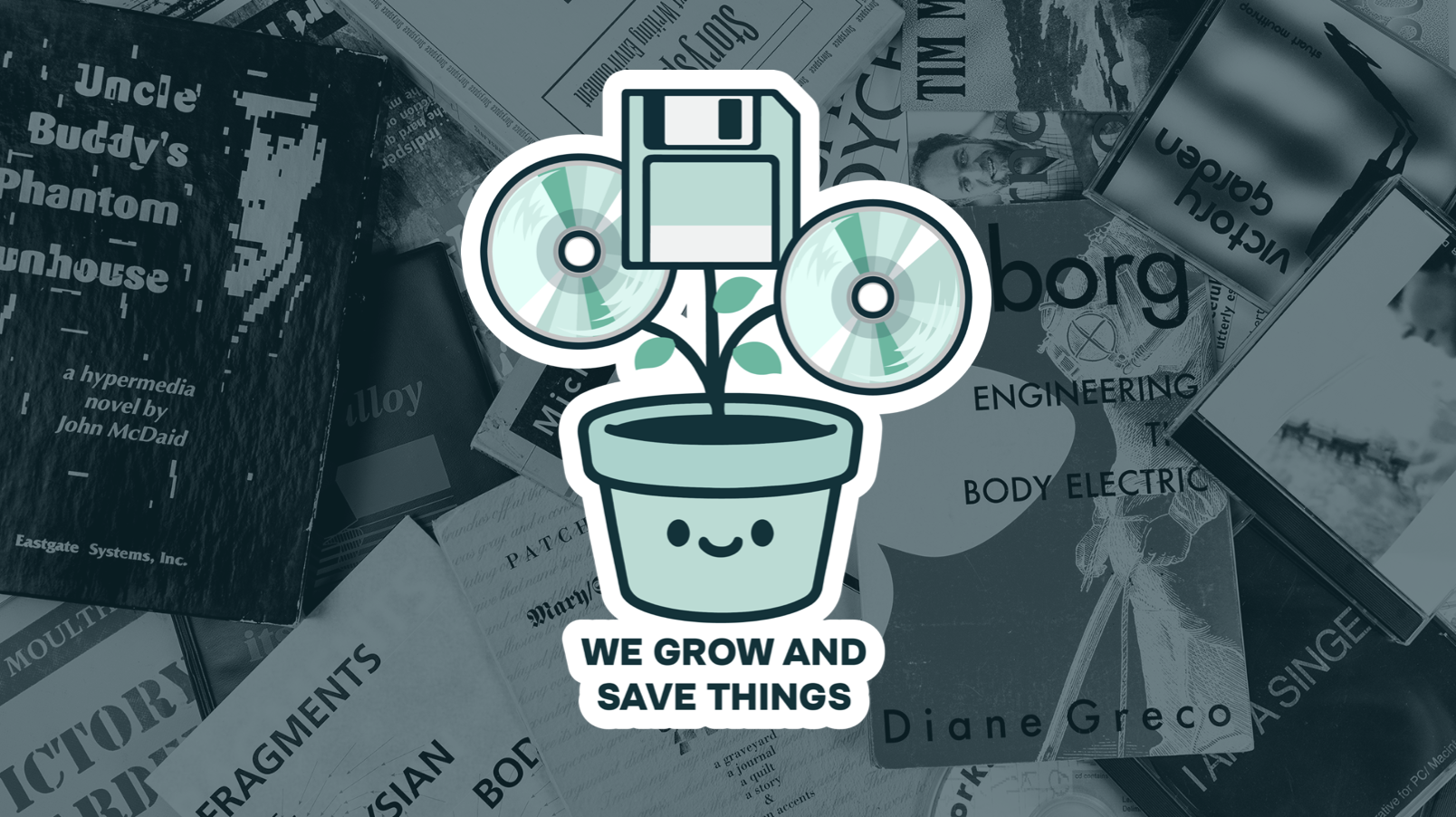
It has evolved over time in a logical way as needs and opportunities arose.
Our history is documented in detail on our website, but briefly I’ll say that we started with the idea of a reading room, where scholars could come and access born-digital literature, art, and games that were published on physical media, like floppy disks and CD-ROMs and, so, not accessible on contemporary computers––materials I had been collecting for years.
From there, thanks to Anne Balsamo, who visited the lab on this very day in 2012, and Stuart Moulthrop we began to document works so that people who couldn’t travel to the reading room could still experience the work through Traversals via our Pathfinders methodology. Exhibitions also figured largely with the ones we did at the Modern Language Association, Library of Congress, British Computer Society, and other venues.
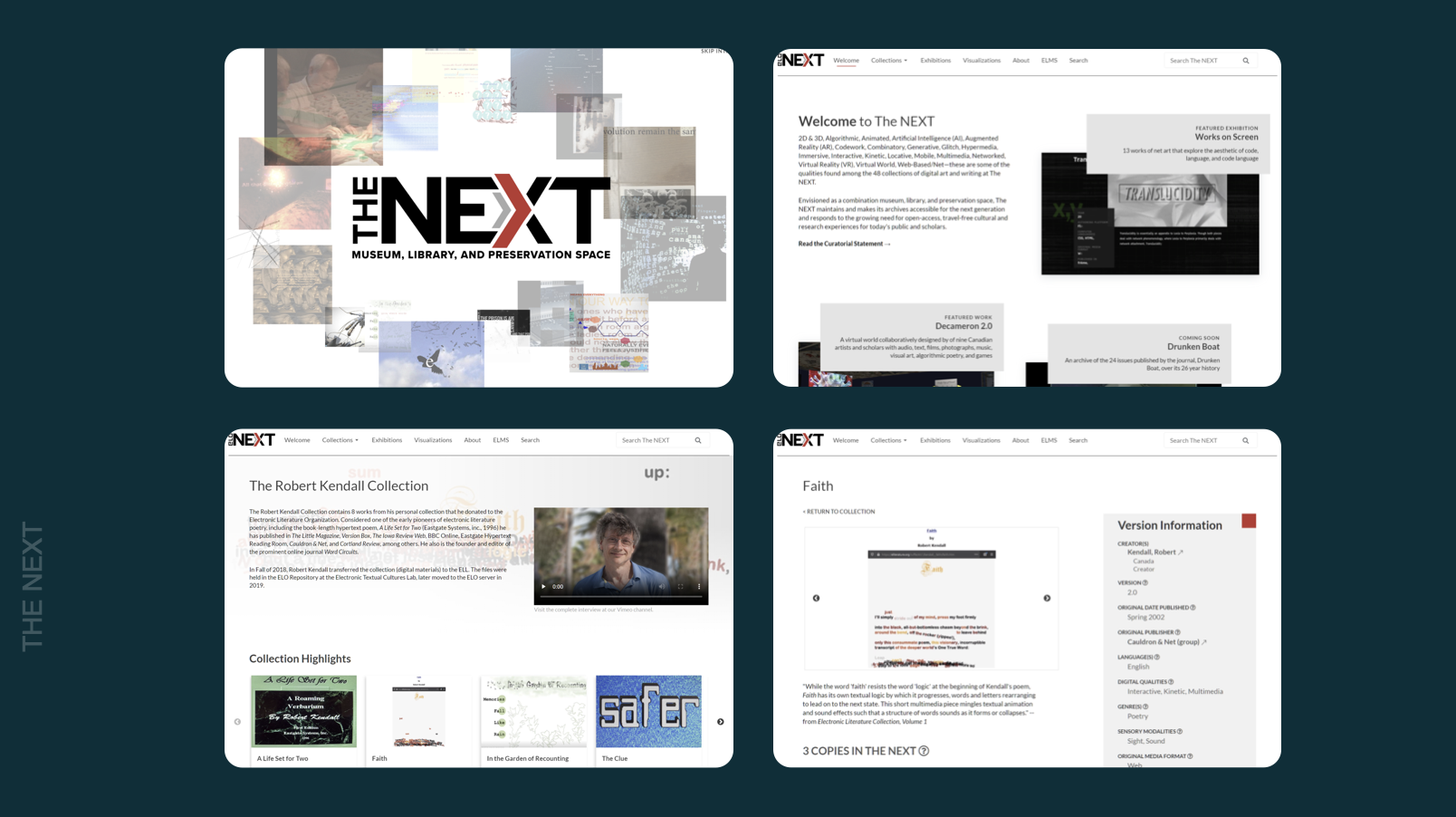 When the trAce Online Writing Centre in England and Turbulence.org here in the US put out calls for a place to host their digital archives, it seemed like the right move to answer their call and build a repository to hold their archives. With seed money from The Andrew W. Mellon Foundation, the Electronic Literature Repository was born. By 2020 we recognized that the repository’s system was not robust enough for our needs. So, with the support of graduating seniors from the DTC Department, one of whom is with us today (Katya Farinsky Wade), and members of the lab we, launched the first iteration of The NEXT, a virtual museum and library built in open Web languages in Semantic Markup and enhanced with ARIA, that now holds 48 collections of works.
While building that first repository, we found that the metadata schema we were using to describe the works we were collecting, MODS, was insufficient for our needs. This recognition took us to develop our own schema, called ELMS, or the Extended Electronic Metadata Schema, that took into consideration the qualities of born-digital media that are participatory, interactive, and experiential––what we call “PIE.”
It also drove us to develop a method for versioning works so that visitors would know the differences, for example, between the third version of Judy Malloy’s Uncle Roger created with AppleSoft BASIC for access on the Apple II and the 5th created for computers accessing the Web.
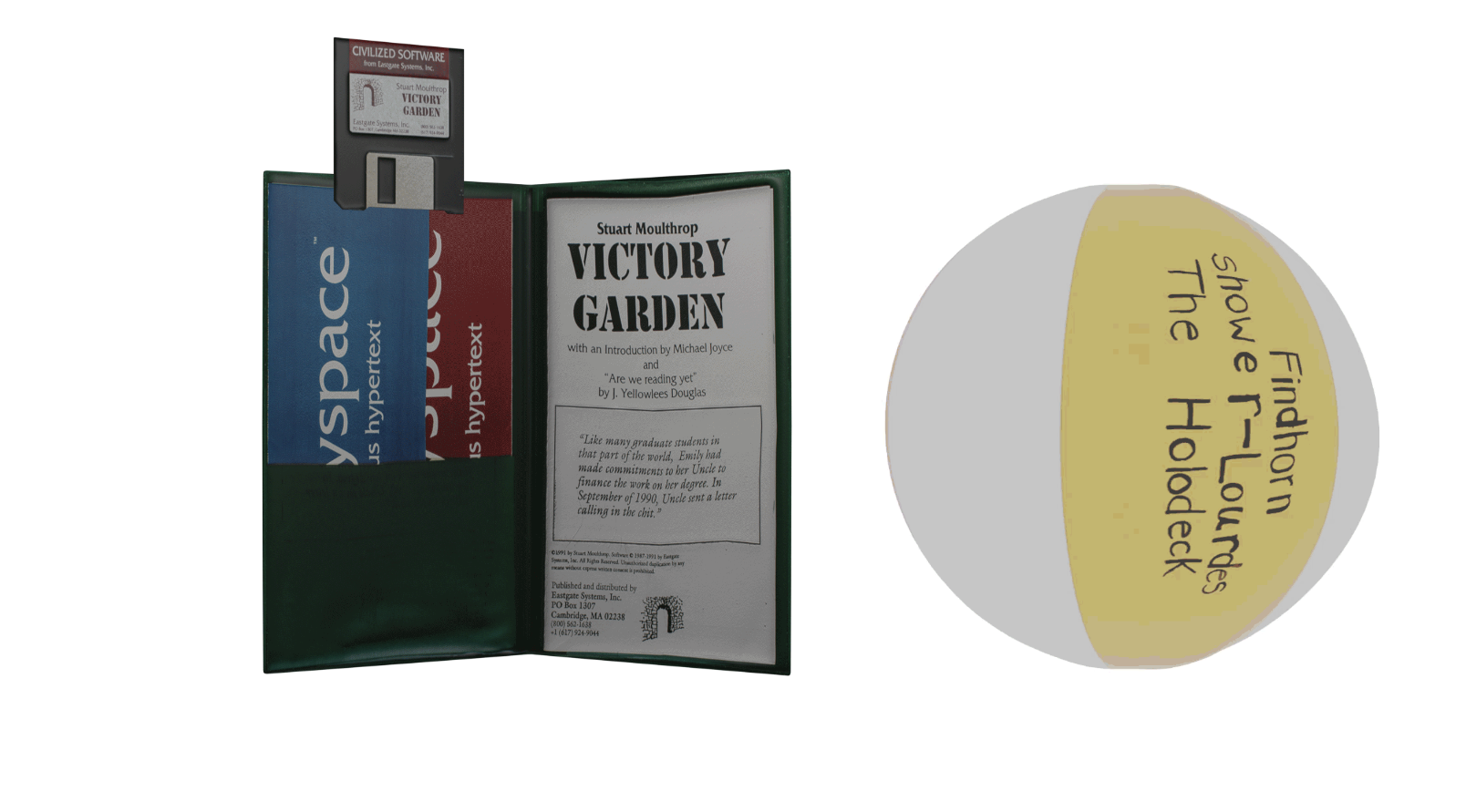 Along with the growing number of digital files the lab was holding came physical archives. We decided when launching The NEXT that we’d include ways to visualize some of the more unique examples, such as folios holding physical media, like this one belonging to Stuart Moulthrop’s Victory Garden and the beach ball that Richard Holeton used when performing his hypertext novel Figurski at Findhorn on Acid. These physical artifacts were created as interactive 3D models made accessible via the Web browser. This approach to archiving means scholars can study important cultural artifacts without needing to travel to the lab.
Of course, when hosting and exhibiting digital files, one discovers that some aspect of a work––or even all of it––is not accessible due to obsolete file formats, like .mov, so the lab began restoring works by updating outmoded formats. Restoring works quickly gave way to reconstructing those created originally with systems no longer accessible, like HyperCard and Hypergate, in open Web languages. To date, we have reconstructed nine hypertext novels and essays.
A grant from the Alfred P. Sloan Foundation to experiment with text in virtual environments provided us training in WebXR, an open-source method for browser-based access. This experience led to the lab to showcase the 3D models of physical archives not just via the browser but also in the VR environment.
This work, then, led us to rethink the concept of archival practice as archival storytelling by connecting works and their archives in interactive, immersive space of VR, which is where we are now.
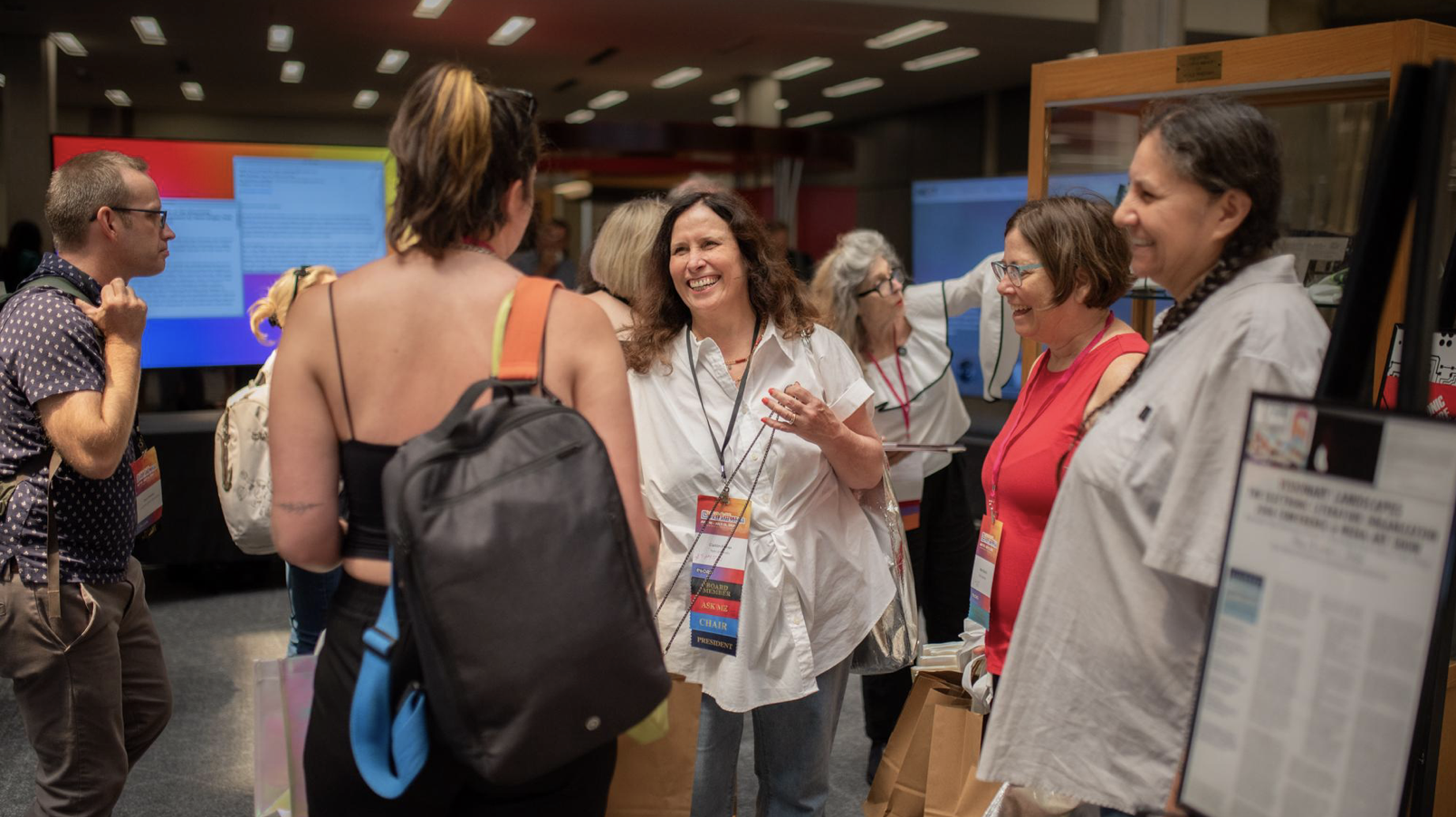 So, while from the outside it may seem that we’re focused on “stuff”––computers, floppy disks, CD-ROMs, digital files, and the like, at the heart of what we are “growing and saving” is the creative expression and intellectual output of artists and scholars who have labored so very hard to remind us of our humanity, to help make sense of the human condition, to take us out of the mundane and everyday into new ideas and along new paths. Of late, the work of humanists has been under fire and the contributions of the Humanities, sorely misunderstood. The work we’re doing in the lab, we hope, is a call to action for all of us to nurture, care for, and tend to this garden of humanity so that it endures and thrives. Our cultural heritage depends on it.
A special thank you to Holly Slocum, the lab’s Senior Designer, for the gorgeous slides, stickers, and logo. Thank you to Rylan Eisenhauer for handling the video production for the event and to Caitlyn Kruger-Lesperance for monitoring the Zoom chat, handling the social media and organizing the event. As always, thank you to Greg Philbrook, our tech guru, for making sure that the tech worked.