
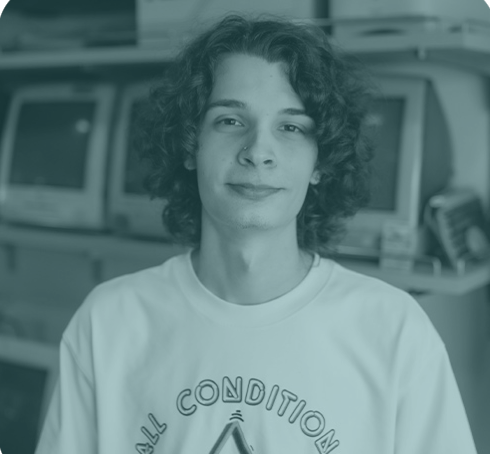
 We are excited to announce that Brody Rodda, an undergraduate majoring in Digital Technology and Culture and a current ELL Fellow, received the 2026 Undergraduate Research Grant from WSU Vancouver. Starting June 1, he will be working with us to catalog all of the computers the lab owns and uses for their research.
As he wrote in his proposal:
“This project is important because currently sites like eBay and Wikipedia provide metadata that can be helpful for cataloging computers; however, because the lab’s computers are donated and many have been updated or modified and often contain legacy software, the lab needs develop a more precise system for cataloging their hardware. It is also important to point out that there is no one way to describe hardware, which then means that there is often missing information needed when we consult various online sites.
The Electronic Literature Lab is unique in that it is one of the only media archaeology labs that specialize in born-digital preservation. Other labs, like the Media Archaeology Lab (MAL) at UC Boulder (https://www.mediaarchaeologylab.com/collection/hardware) and Trope Tank at MIT (https://tropetank.com/inventory/index.html) collect legacy hardware, but neither for the purpose of preservation activities. Also when looking at their catalogs, it is clear that the way they present information is inconsistent and not necessarily following a specific structure. Even sites like eBay and Wikipedia do not offer an established schema for hardware metadata.
To do this work, I will evaluate the way in which other labs and sites, mentioned previously, have catalogued their hardware and produce a metadata schema based on this research. Then, I will go through a select number of computers held by the lab, adding the information about them in the metadata spreadsheet I created. This step will help me see the gaps in the metadata used by others and able to expand my schema to address them. . . . Because computers are often donated to ELL, this information important to document. I suspect there will be other information I will need to add with my research.”
His work will be completed on August 14, 2026.