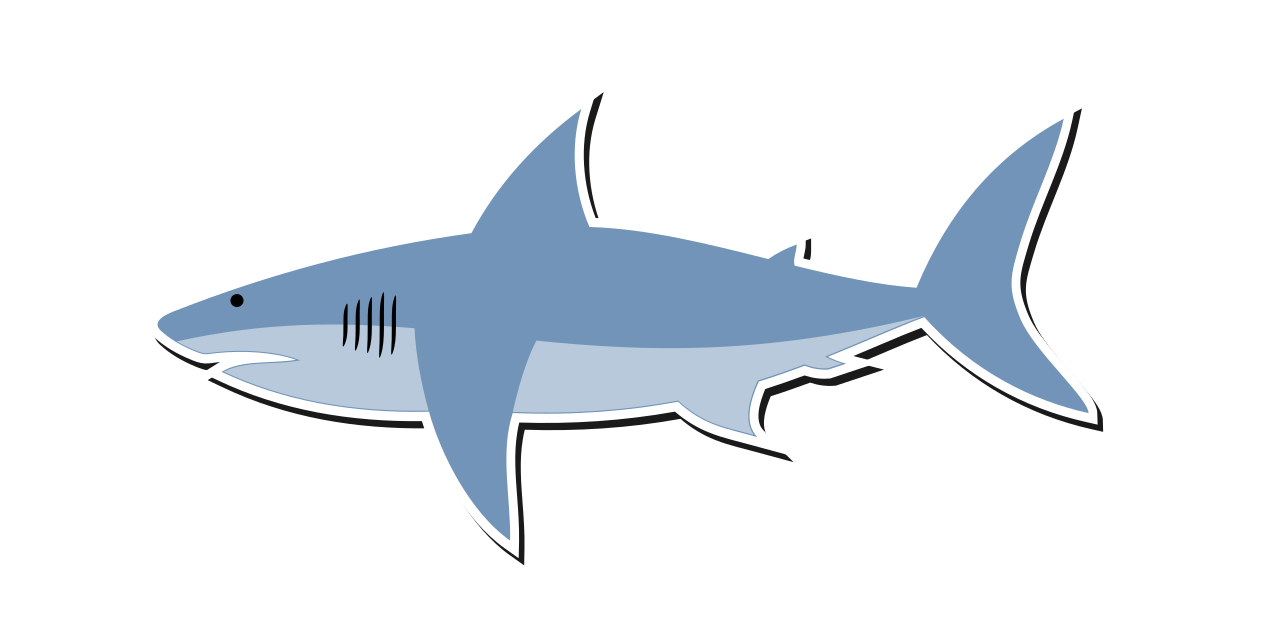
The gills are what allow the shark to breath. Without gills, the shark will be unable to breath and die. Gills contain a large number of capillaries, maximizing the amount of oxygen they absorb out of the water. When the shark opens its mouth, the water runs over its gills, and the blood in the capillaries (the smallest blood vessels that deliver blood, nutrients and oxygen to cells throughout the body) picks up the oxygen that is dissolved in the water. Without Gills, the blood in the capillaries will not be able to pick up that dissolved oxygen which would have dire consequences. Additionally, Gills only work when they are underwater. If you took the shark out of the water, the strands of the gills would collapse. this collapsing of the gills would get rid of all the valuable surface area that is required for enough oxygen to diffuse.
The jaw of a Great White Shark is approximately 2.5 feet wide and 2.2 feet high. This size allows the shark to hunt larger prey, even other sharks with relative ease. The average Great White Shark has about 300 teeth that are arranged in several rows. It is estimated that the Great White can produce over 20,000 teeth during their lifetime. Sharks have evolved to have super sharp teeth so they can bite and grab slippery prey that would otherwise escape the grip of dull teeth. They reproduce new teeth so if one breaks or falls out, they can grow a new one, allowing them to continue hunting. This indicates that sharks may lose a lot of teeth in their lifetime. Their teeth continually grow throughout their life and move forward in their mouth like a conveyor belt, maturing as they go on.
The pectoral fins appear on either of the sharks’ sides and are like the arms of the shark, specifically, right behind the gill slits along the pectoral muscle line. They are thought of, by many, as the wings of a shark. The pectoral fins act as the steering wheel for the shark, allowing them to move up and down in the water, turn left or right, and even roll its body. They also help the shark maintain its balance and stability when they swim at faster speeds. Some shark's pectoral fins are highly flexible, allowing them to control their movement more efficiently. Depending on the type of shark, they are usually the largest fins on the shark.
The dorsal fin is located on top of the shark on the middle of its back. This is often the fin most people think of when thinking about sharks. This is most often the first thing you will see of the shark when it is swimming super close to the top of the water. The dorsal fin is tall, shaped like a triangle and sticks straight up like a knife. Much like pectoral fins, the dorsal fin is used to help the shark stabilize while swimming in the water, helping it stay upright and prevent it from tipping on its side or back, and helps it make sharp turns while swimming at fast speeds.
The caudal fin is located at the very end of the shark. The caudal fin is the fin the shark uses to swim, propel itself forward and slowdown in the water. The top half of the caudal fin is known as the dorsal portion. The bottom half of the caudal fin is known as the ventral portion. The dorsal portion is always bigger than the ventral portion due to the spinal column running through the dorsal portion, which allows for increased muscle use and development. The caudal peduncle is right behind the caudal fin and acts as its base, where peduncle stands for stem. Some species use their caudal fin for self-defense and killing their prey.
The pelvic fins are located at the bottom of the shark. These are typically the smallest fins on a shark. They are different depending on whether the shark is male or female. The pelvic fins are on either side cloacal aperture, which is what receives products of the intestine and serves as the urinary system. Similar to the pectoral and dorsal fins, the pelvic fins help the shark maintain stability and balance when swimming in the water. For males, pelvic fins have a secondary function called claspers, which are modified into copulatory organs. Claspers serve as the sperm transferer while the shark mates.
The second dorsal fin is located on top of the shark just behind the main dorsal fin. This fin is a lot smaller in size than the main dorsal fin. This is another fin that helps the shark stabilize when swimming through the water, helping it stay upright and keep it from tipping over on either side, mostly serving the same function as the main dorsal fin. The second dorsal fin helps the shark stabilize and maneuver its back a lot better.
The anal fin is located at the bottom of the shark behind the pelvic fins and in front of the caudal fin. The primary function of the anal fin is to provide further stability of the shark while it swims through the water. Though most sharks have an anal fin, not all sharks have them.
The nostril and eyes are located on the head and face of the shark above the jaw. The nostril helps the shark smell and pick up scent, the eyes help the shark see. Both give the shark the ability to search and hunt for prey. Shark eyes are highly adaptive to a wide range of lighting conditions, from super bright light to ultra dim darkness. Shark eyes have a large concentration of rod cells, which are extremely sensitive to light, as well as movement, which allows the shark to see in dark environments. Although sharks are able to see in different lighting environments, they have very limited color vision. As for the nostrils, also called nares, they are quite unique and function differently from the nostrils on most other animals. When water moves in to one of their nares, it moves through a nasal sac, and out the other nostril. During this process, the shark's receptors pick up smells, and sends the messages to the shark's brain.