The Bond That Broke the Stars

A Visual Poem by Dakotta Bhatti
He loved him first
as a promise—
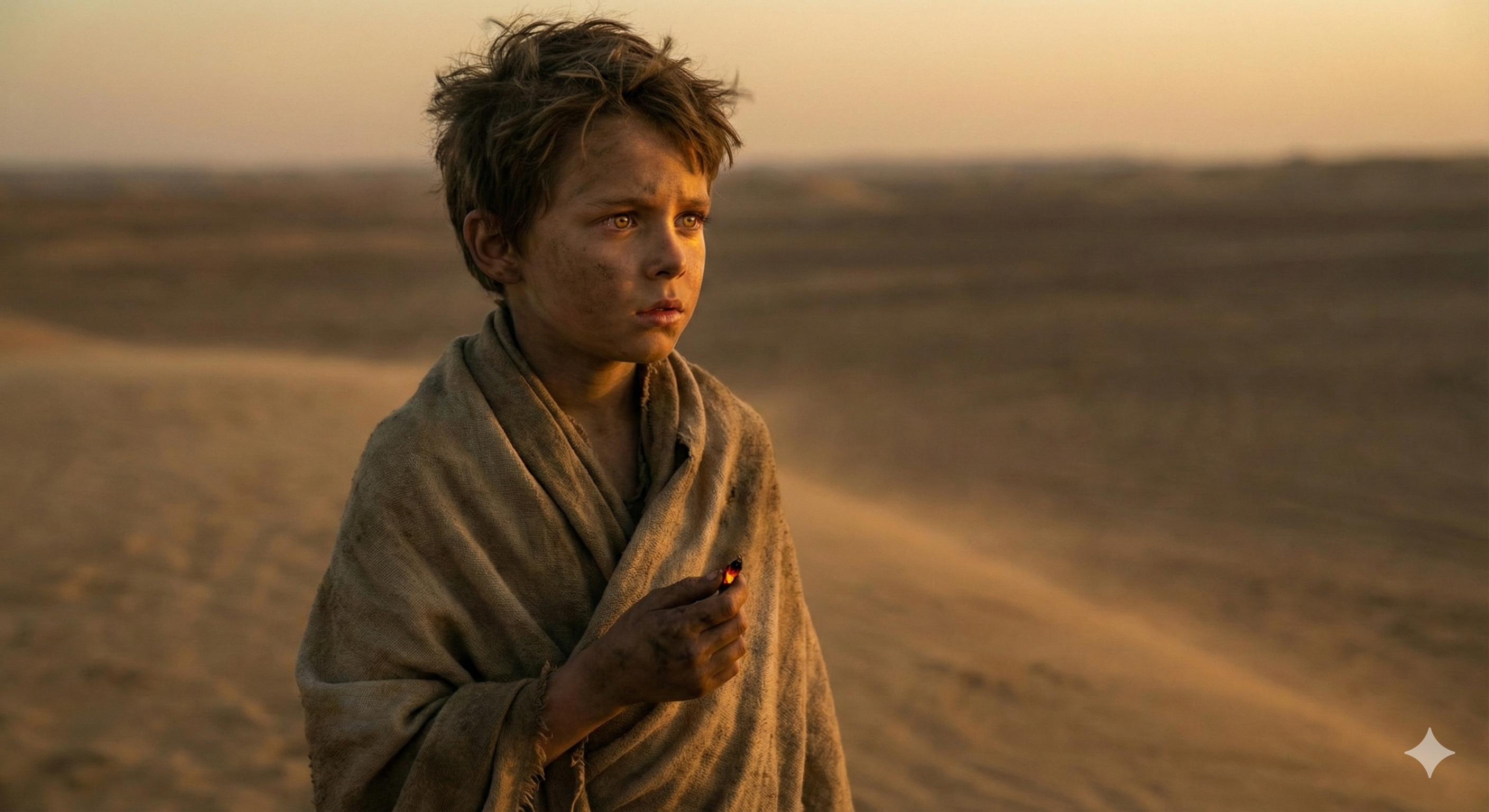
a small, fierce spark wrapped in desert dust,
eyes wide with impossible futures
and a heart that beat loud enough
to challenge fate itself.
Obi-Wan watched that boy grow
like a sunrise with a sword in its hand.
Every lesson shared between them
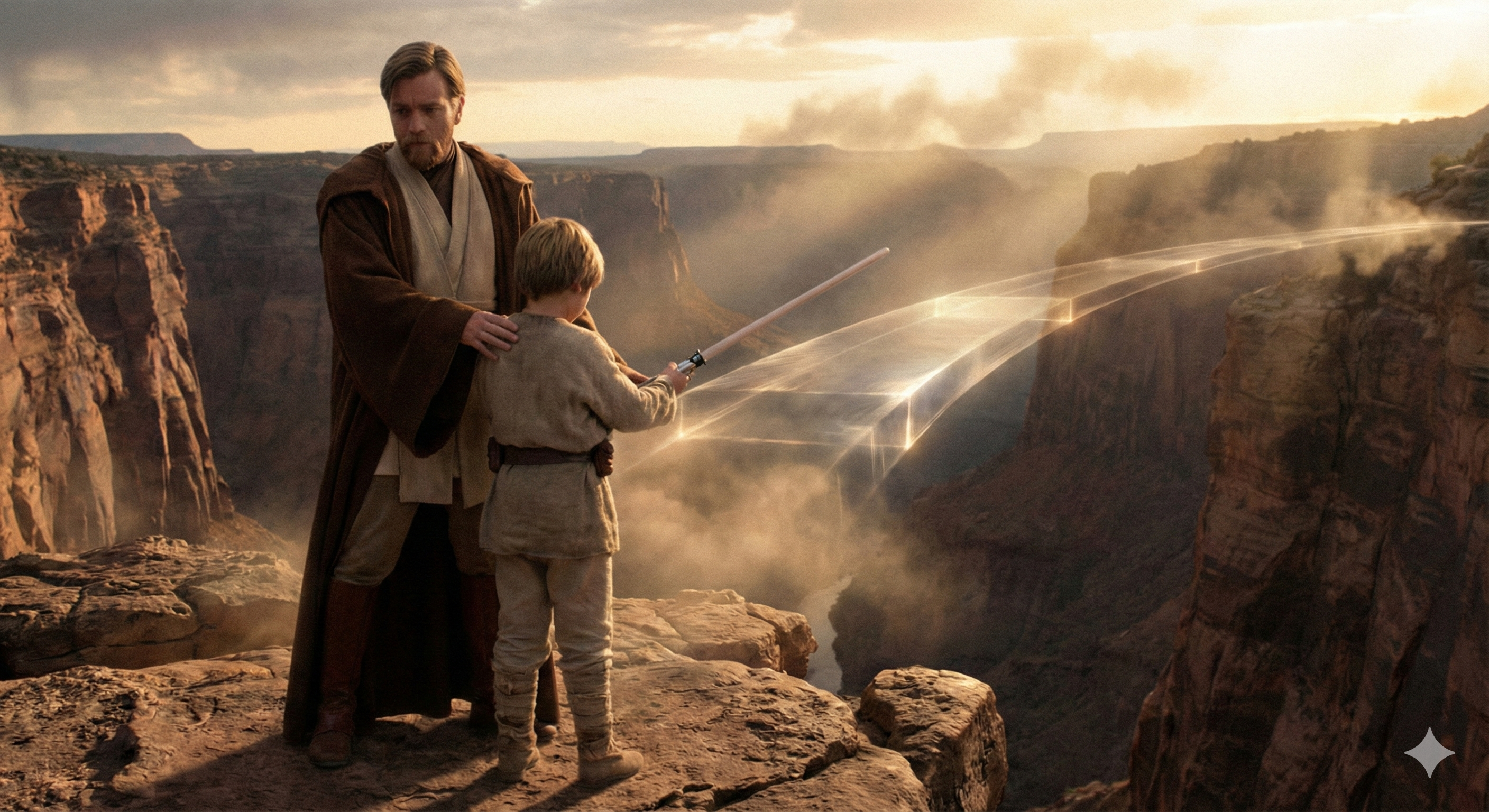
felt like building a bridge
over a chasm the galaxy couldn’t yet see.
He corrected his stance,
softened his grief,
tempered his fire—
not to restrain him,
but to protect the world
from losing a light too bright
to burn alone.
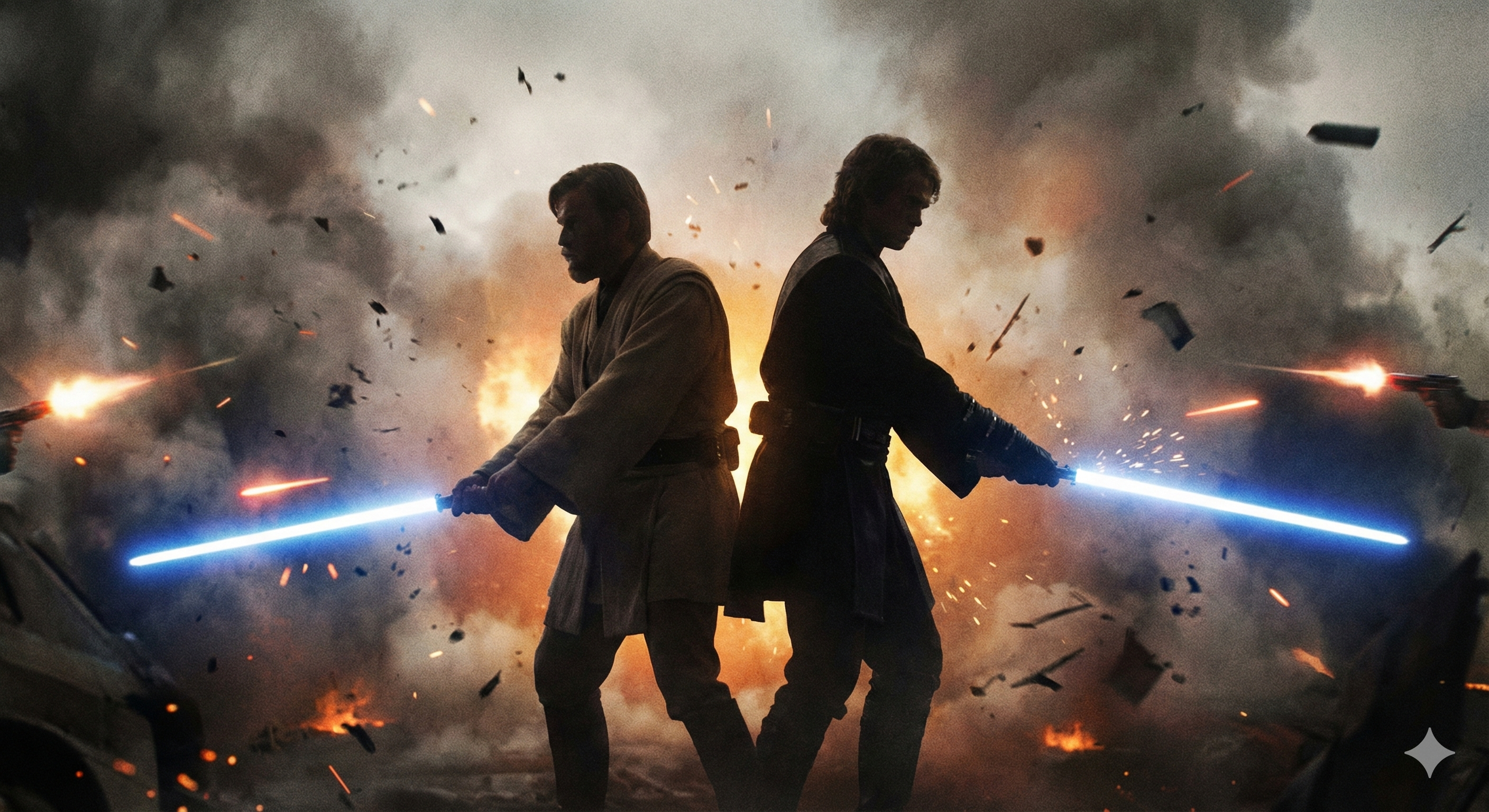
On battlefields,
their silhouettes moved as one—
two halves of a single strike,
a dance of trust
woven through smoke and shrapnel.
Theirs was a language
spoken only in shared danger:
the glance before the leap,
the nod before the charge,
the unspoken certainty
that neither would ever let go.
But love is cruel in war.
It stretches thin—
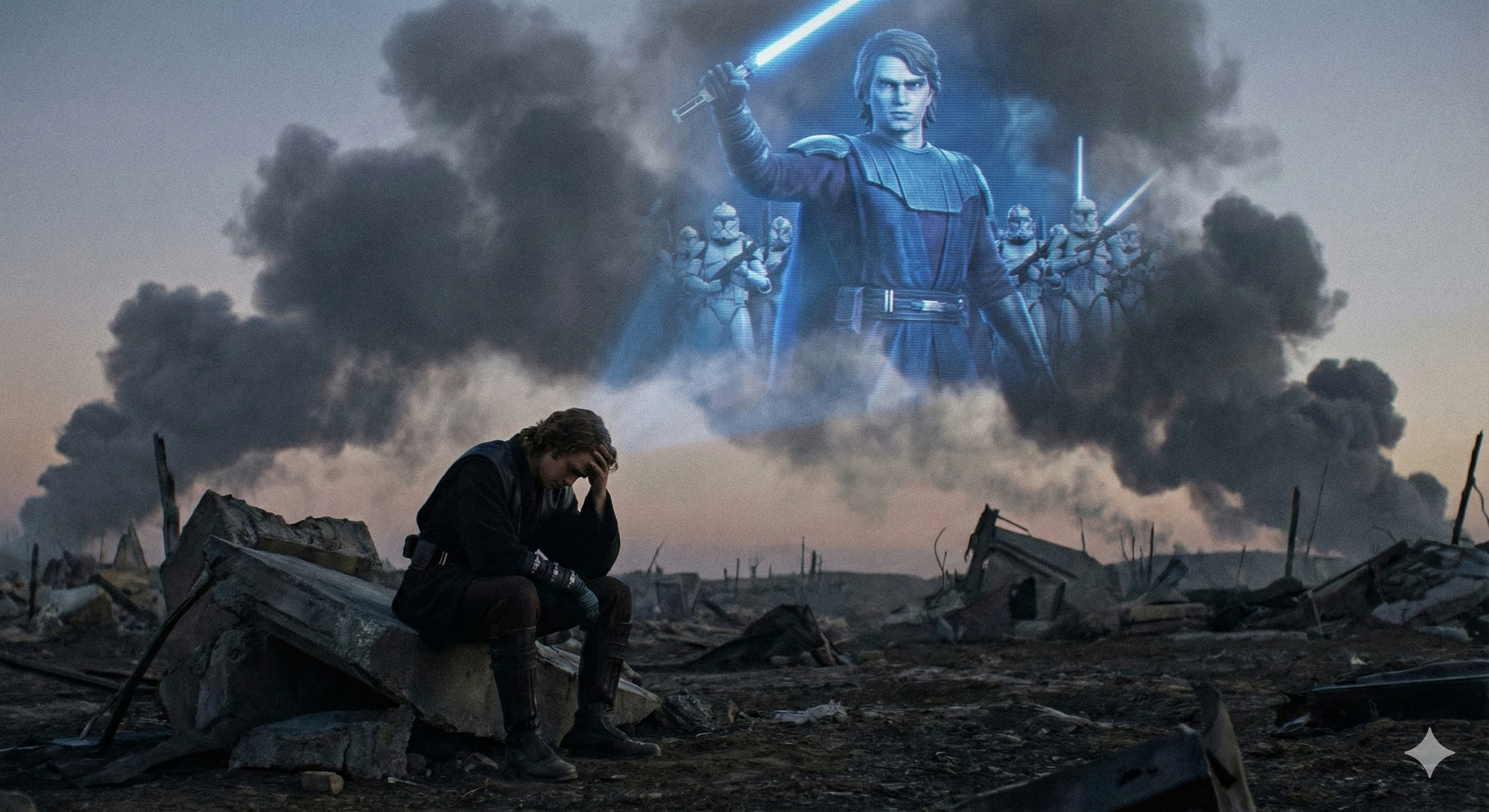
man becomes myth,
myth becomes expectation,
and expectation becomes weight
Obi-Wan saw the cracks first:
the tremor in Anakin’s voice
when fear masked itself as certainty,
the way his rage glowed
like a torch held too close to the hand.
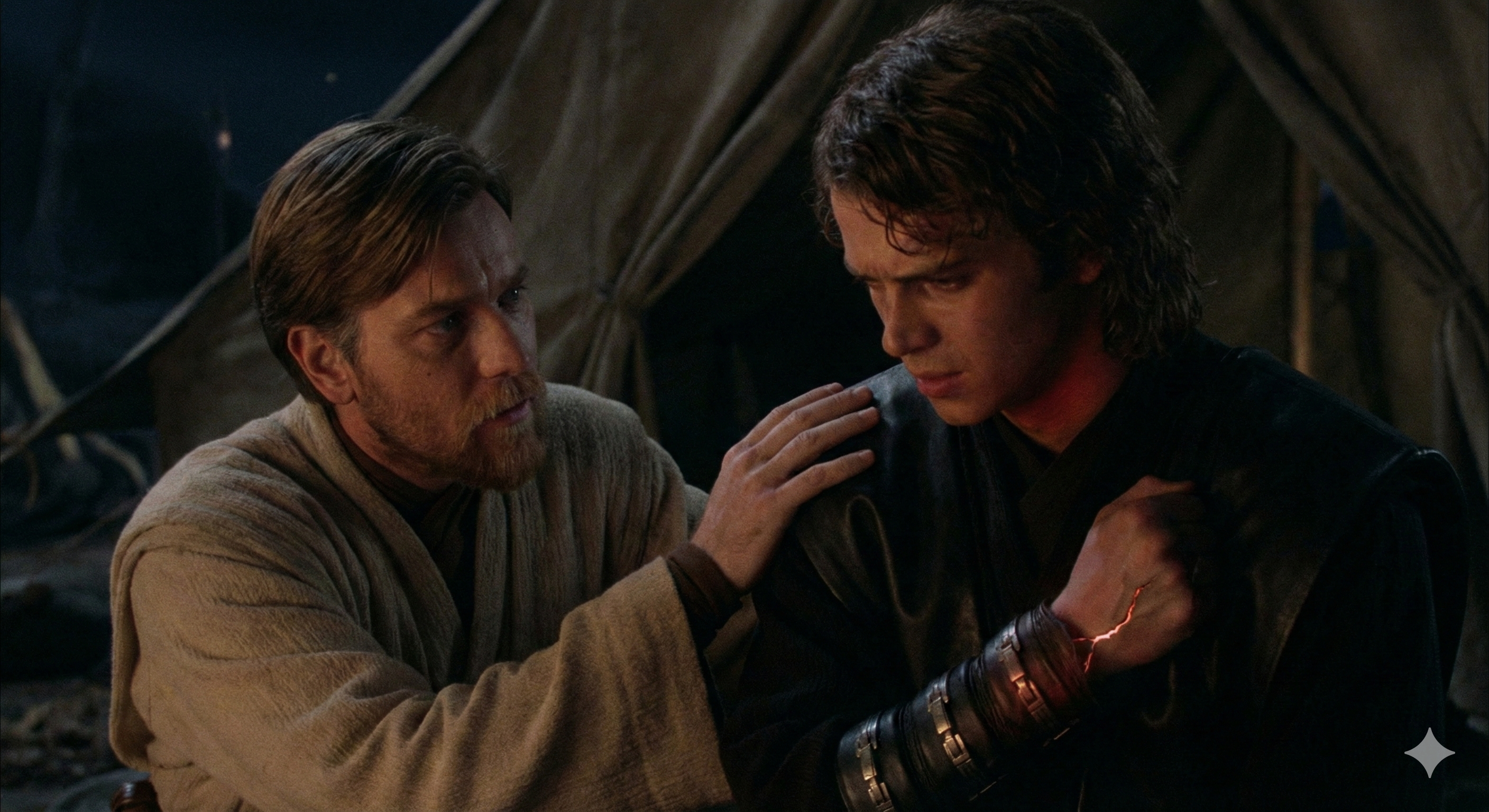
Yet every time,
Obi-Wan reached out—
gentle, patient,
as if he could press his palm
against the fractures
and persuade them to heal.
And when the darkness finally took him,
it was not betrayal
that broke Obi-Wan’s heart—
but the echo of the child he once knew,
screaming through the armor of a man
who didn’t know how to be saved.
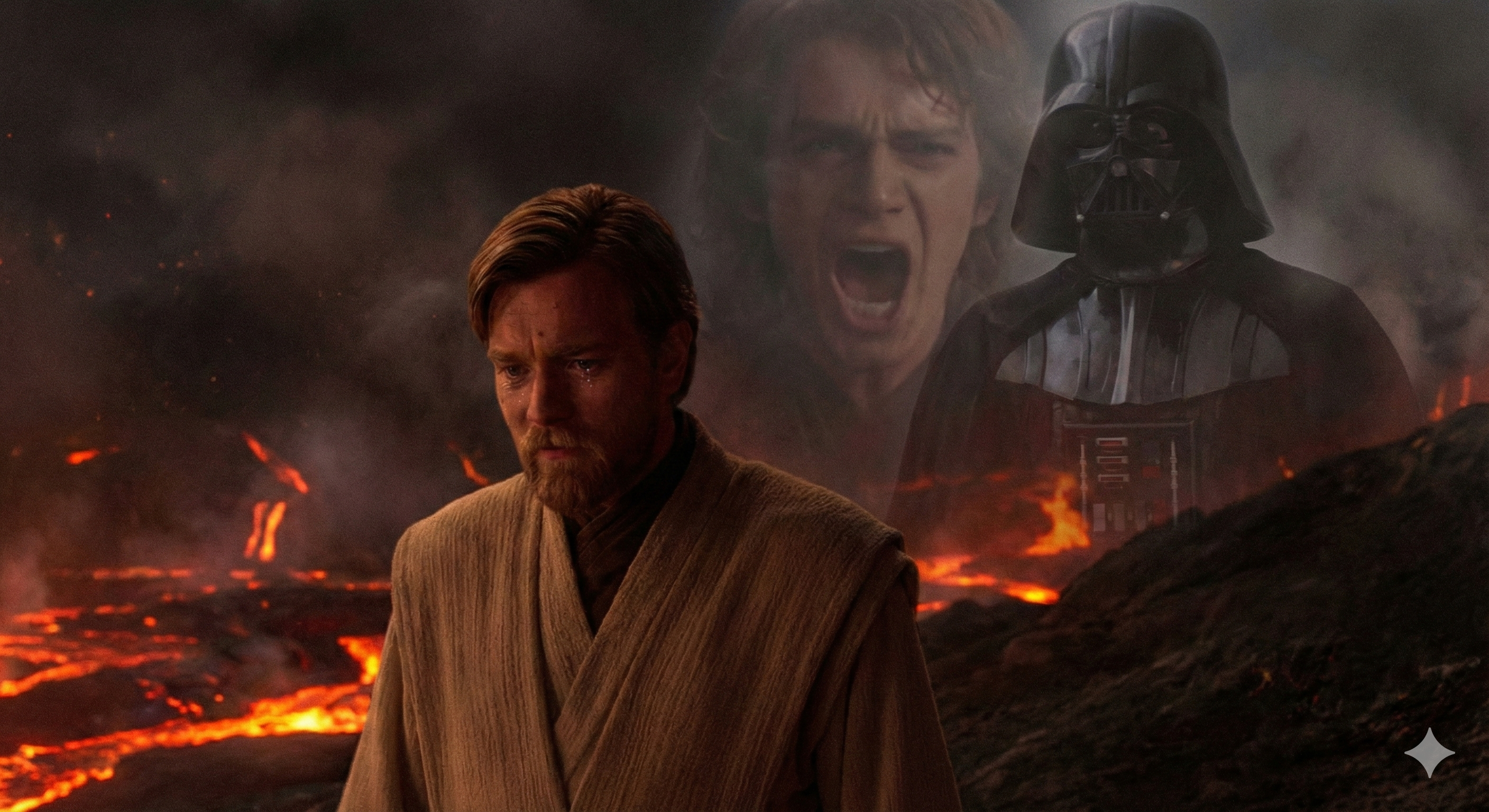
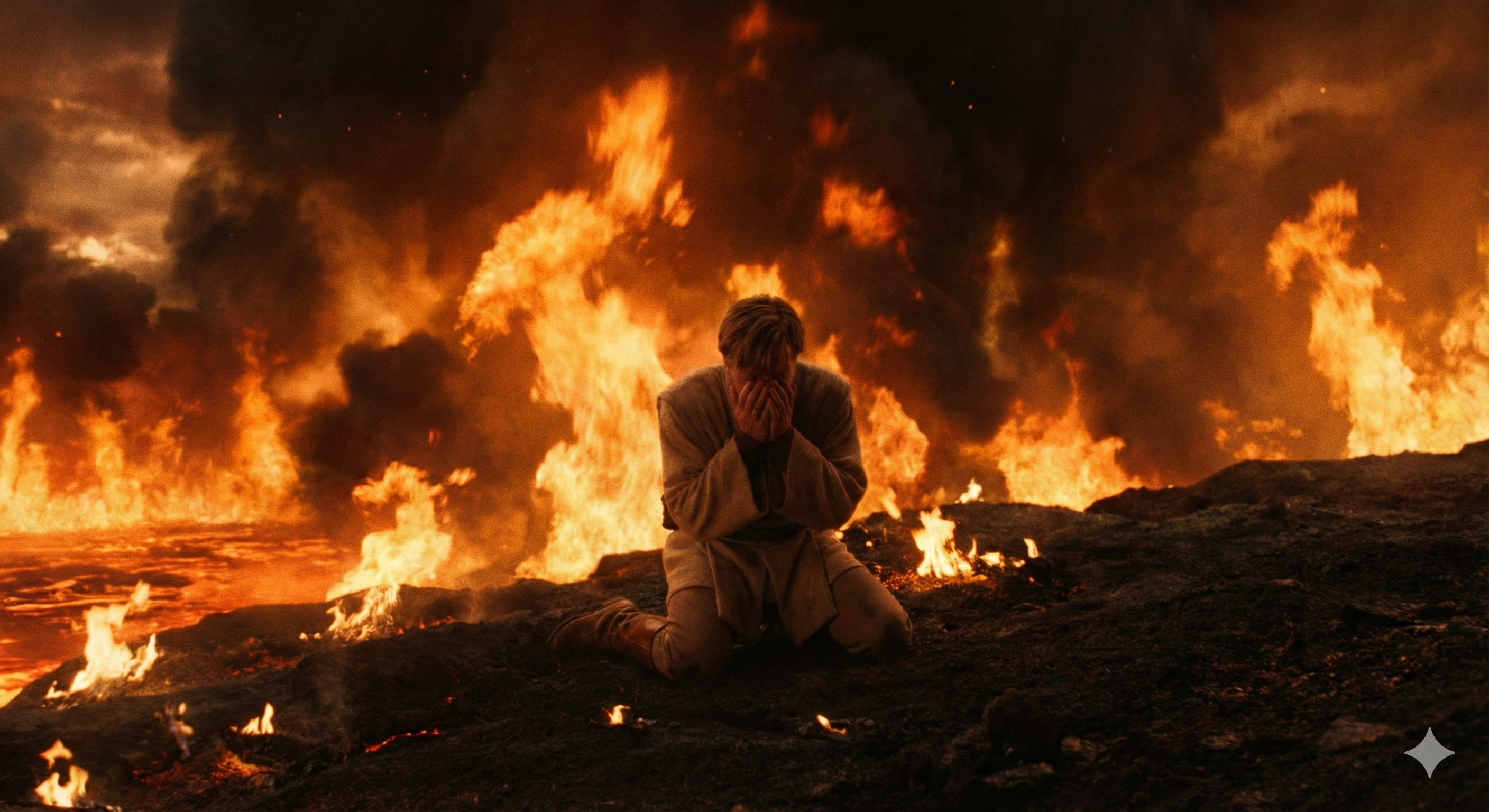
On the scorched bank
of their last meeting,
as fire clawed at the sky
and the future burned with them,
Obi-Wan wept
not for the warrior lost,
but for the friend
he could no longer reach.
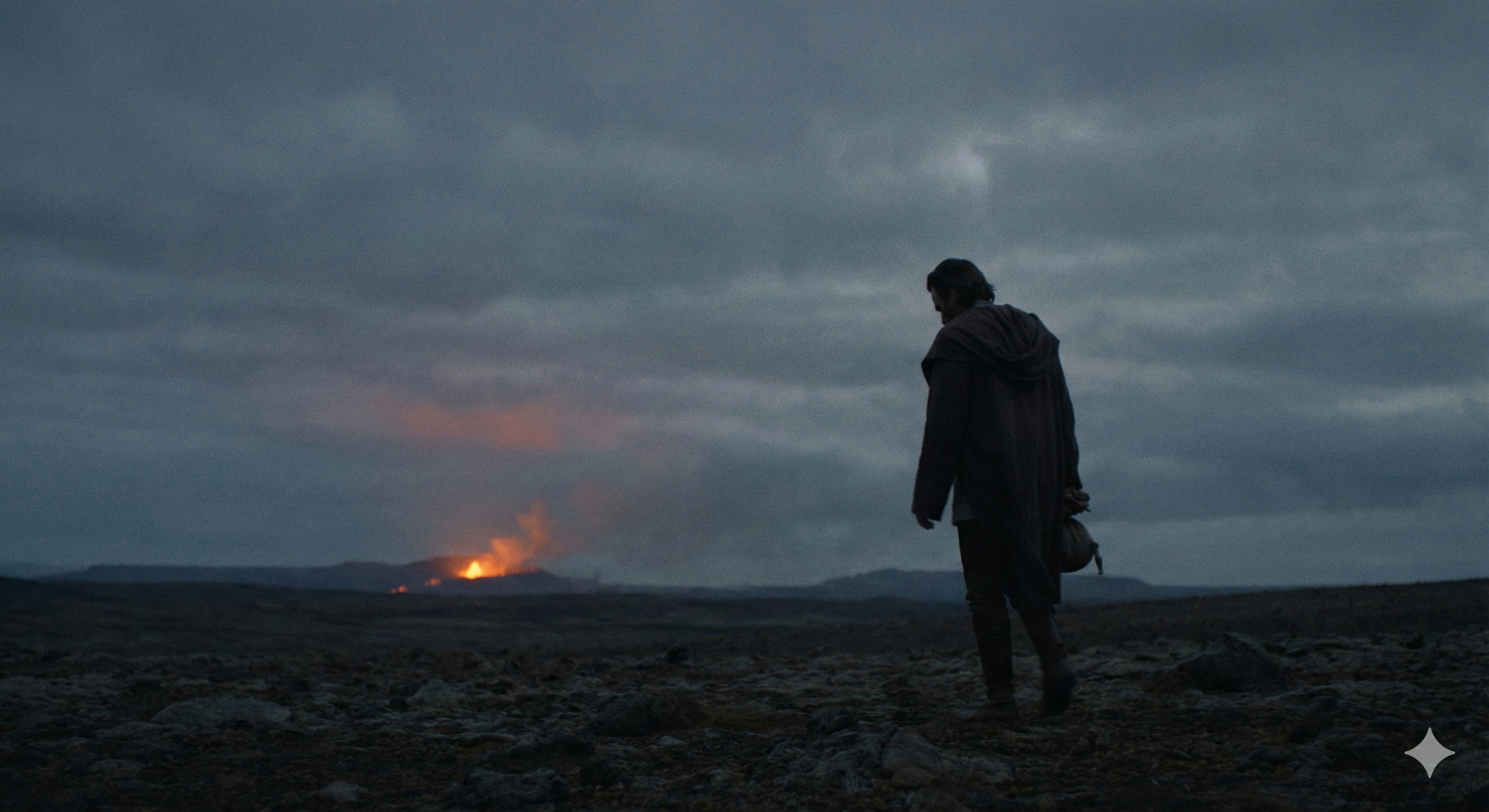
He walked away
with a wound deeper than any blade—
the kind carved by love,
loyalty,
and the unbearable truth
that sometimes the person you would die for
is the one you must leave behind.
And yet,
even in exile,
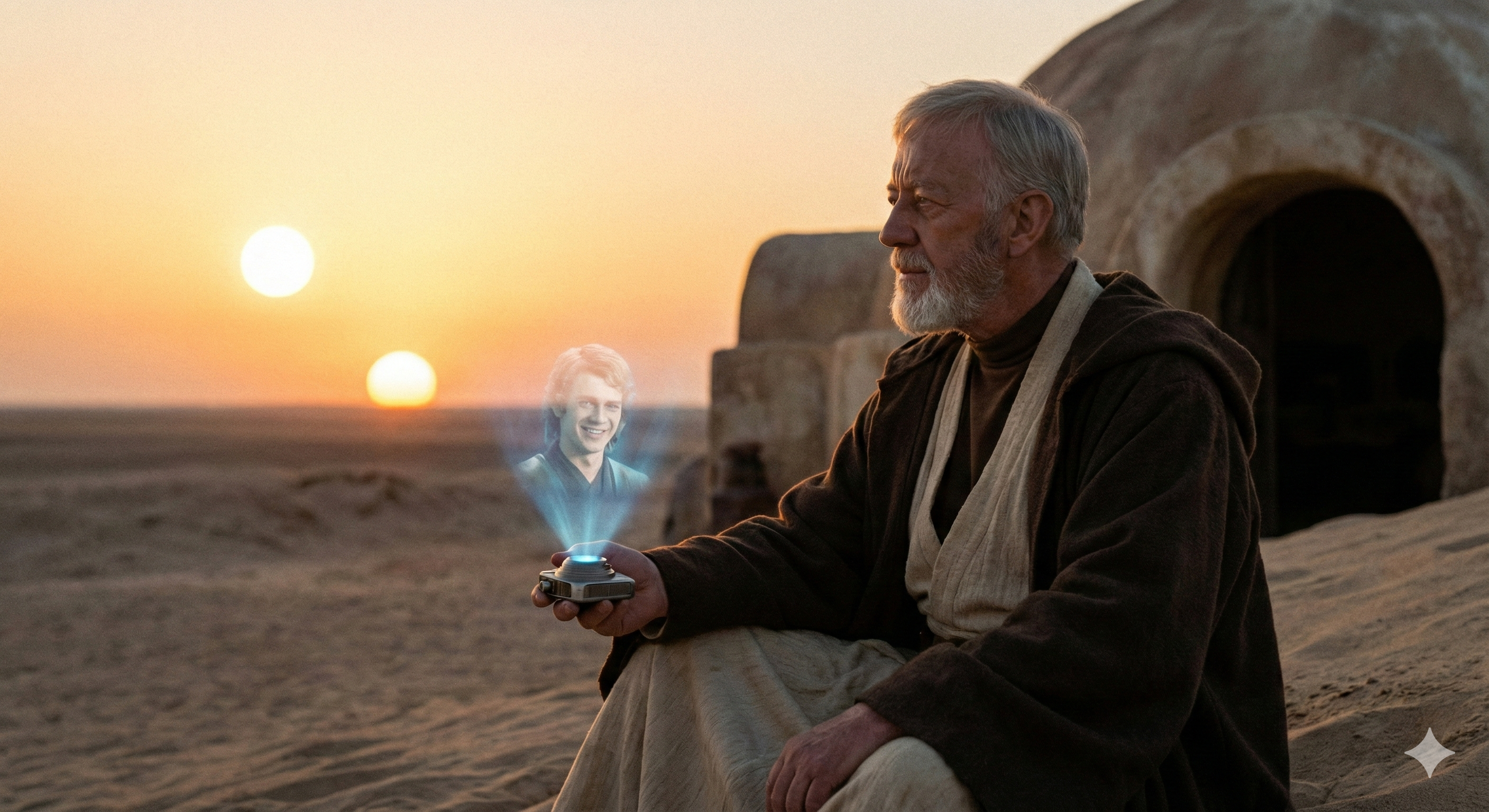
in the silence of twin suns setting,
his love remained—
a quiet ache,
a flicker of memory,
a light he carried alone
because someone had to remember
who Anakin once was.

Visual Archive: Sequence of Stanzas

Stanza 1 Visualization

Stanza I

The Promise & The Spark

Stanza 2 Visualization

Stanza II

The Bridge of Light

Stanza 3 Visualization

Stanza III

Silhouettes in Smoke

Stanza 4 Visualization

Stanza IV

Myth & Expectation

Stanza 5 Visualization

Stanza V

The Torch & The Cracks

Stanza 6 Visualization

Stanza VI

The Echo in the Armor

Stanza 7 Visualization

Stanza VII

The Scorched Bank

Stanza 8 Visualization

Stanza VIII

The Unbearable Truth

Stanza 9 Visualization

Stanza IX

The Twin Suns

Echoes in the Machine: Visualizing Grief through Algorithmic Collaboration

Introduction: The Weight of Myth

For Project 5, I chose to explore the aesthetic of "Cinematic Tragedy" through a narrative series entitled The Bond That Broke the Stars. The core of this project is an original poem that deconstructs the relationship between Obi-Wan Kenobi and Anakin Skywalker—not as a space opera action sequence, but as an intimate tragedy of fatherhood, failure, and grief.

My objective was to investigate a specific question regarding human-machine entanglement: Can a generative AI, which possesses no capacity for emotion or nostalgia, effectively visualize the abstract metaphors of human heartbreak? We often think of AI image generation as a tool for creating "cool" fantasy art, but I wanted to push it toward emotional translation. I wanted to see if the machine could take a line like "expectation becomes weight" and render it as a physical reality.

The Hybrid Workflow: Prompting as Translation

My process was a recursive dialogue between myself (the poet/director) and the AI (the cinematographer). It was not as simple as pasting the poem into an image generator. When I fed raw verse into the model, the results were often too literal or nonsensical. To achieve the final artifact, I had to engage in a process of "metaphorical translation." For each stanza, I followed a specific workflow:

This process revealed that the AI acts less like a painter and more like a logic engine. It does not understand "grief," but it understands "shadow," "blue light," "film grain," and "downcast posture." My role was to map the former onto the latter.

Analyzing the Artifacts: When Metaphor Becomes Pixel

Three specific images in the series highlight the success and the friction of this human-machine entanglement.

1. The Architecture of Connection (Stanza 2)
The poem describes the relationship between the characters as "building a bridge / over a chasm the galaxy couldn’t yet see." A literal interpretation might have shown two construction workers. Instead, I worked with the AI to create a surreal, "mythic" image. We generated a physical canyon (the reality) but overlaid a "translucent bridge made of light" (the metaphor). The AI successfully rendered this non-existent structure, creating a visual representation of potentiality. It captured the course theme of The Uncanny—an image that looks photorealistic but contains elements that defy physical laws, representing the spiritual bond of the Force.

2. The Weight of Expectation (Stanza 4)
One of the most challenging verses was: "man becomes myth / myth becomes expectation / and expectation becomes weight." How do you photograph "expectation"? Through the generative process, I realized we needed to play with scale. We generated an image of the human character sitting small and crushed among rubble, while a massive, distorted holographic projection of his "heroic self" loomed over him in the clouds. The AI’s ability to render the hologram as oppressive and atmospheric turned an abstract psychological concept into a concrete visual threat. This connects to the aesthetic of the Sublime—the feeling of being overwhelmed by something vast and powerful, though in this case, the terror comes from within.

3. The Ghost in the Machine (Stanza 6)
The visual climax of the piece is the visualization of the line "screaming through the armor." This required the most heavy-handed "steerability" from me. I realized that a standard picture of the villain wouldn't work. We needed to see the internal conflict. The final image—a reflection of the armored mask with a screaming child ghostly superimposed within it—is a pure example of digital layering that would be difficult to capture in traditional photography. The AI "hallucinated" the ghost inside the machine, perfectly serving the poem's theme of lost humanity.

Reflection on Authorship and Entanglement

Throughout this project, my thinking on authorship evolved. Initially, I felt that using AI might dilute the personal nature of the poem. However, I found that the machine acted as a constraint that forced me to be more precise with my imagery. I couldn't just rely on vague feelings; I had to describe exactly what "grief" looked like in terms of lighting and composition.

The resulting artifact is a hybrid. The soul of the work—the narrative arc, the emotional beats, the tragedy—is entirely human. The skin of the work—the texture of the sand, the specific glow of the lightsabers, the film grain—is algorithmic. This creates a "feedback loop" of creativity. The poem dictated the image, but the generated images often surprised me with their mood, which in turn changed how I read my own poem. For example, the final image of the "flicker of memory" (Stanza 9) showed the character holding a tiny hologram against a massive sunset. The AI emphasized the smallness of the memory against the vastness of the universe, a visual contrast I hadn't explicitly written but which elevated the poignant feeling of the ending.

Conclusion

The Bond That Broke the Stars is not just an illustration of a poem; it is an experiment in translating the language of human emotion into the language of latent diffusion models. It demonstrates that while AI cannot feel heartbreak, it can be directed to arrange pixels in a way that evokes heartbreak in the viewer. The project proves that in the age of generative media, the role of the artist shifts from "maker of marks" to "architect of meaning," guiding the machine to find the human ghost within the digital shell.

AI Tools Used

Prompt Logs & Chat Links

View Full Generation Log
See the Reflection above for detailed breakdown of prompts used.
The Bond That Broke the Stars

The Bond That Broke the Stars

A Visual Poem by Dakotta Bhatti
He loved him first
as a promise—
a small, fierce spark wrapped in desert dust,
eyes wide with impossible futures
and a heart that beat loud enough
to challenge fate itself.
Obi-Wan watched that boy grow
like a sunrise with a sword in its hand.
Every lesson shared between them
felt like building a bridge
over a chasm the galaxy couldn’t yet see.
He corrected his stance,
softened his grief,
tempered his fire—
not to restrain him,
but to protect the world
from losing a light too bright
to burn alone.
On battlefields,
their silhouettes moved as one—
two halves of a single strike,
a dance of trust
woven through smoke and shrapnel.
Theirs was a language
spoken only in shared danger:
the glance before the leap,
the nod before the charge,
the unspoken certainty
that neither would ever let go.
But love is cruel in war.
It stretches thin—
man becomes myth,
myth becomes expectation,
and expectation becomes weight
Obi-Wan saw the cracks first:
the tremor in Anakin’s voice
when fear masked itself as certainty,
the way his rage glowed
like a torch held too close to the hand.
Yet every time,
Obi-Wan reached out—
gentle, patient,
as if he could press his palm
against the fractures
and persuade them to heal.
And when the darkness finally took him,
it was not betrayal
that broke Obi-Wan’s heart—
but the echo of the child he once knew,
screaming through the armor of a man
who didn’t know how to be saved.
On the scorched bank
of their last meeting,
as fire clawed at the sky
and the future burned with them,
Obi-Wan wept
not for the warrior lost,
but for the friend
he could no longer reach.
He walked away
with a wound deeper than any blade—
the kind carved by love,
loyalty,
and the unbearable truth
that sometimes the person you would die for
is the one you must leave behind.
And yet,
even in exile,
in the silence of twin suns setting,
his love remained—
a quiet ache,
a flicker of memory,
a light he carried alone
because someone had to remember
who Anakin once was.

Visual Archive: Sequence of Stanzas

Stanza 1 Visualization

Stanza I

The Promise & The Spark

Stanza 2 Visualization

Stanza II

The Bridge of Light

Stanza 3 Visualization

Stanza III

Silhouettes in Smoke

Stanza 4 Visualization

Stanza IV

Myth & Expectation

Stanza 5 Visualization

Stanza V

The Torch & The Cracks

Stanza 6 Visualization

Stanza VI

The Echo in the Armor

Stanza 7 Visualization

Stanza VII

The Scorched Bank

Stanza 8 Visualization

Stanza VIII

The Unbearable Truth

Stanza 9 Visualization

Stanza IX

The Twin Suns

Echoes in the Machine: Visualizing Grief through Algorithmic Collaboration

Introduction: The Weight of Myth

For Project 5, I chose to explore the aesthetic of "Cinematic Tragedy" through a narrative series entitled The Bond That Broke the Stars. The core of this project is an original poem that deconstructs the relationship between Obi-Wan Kenobi and Anakin Skywalker—not as a space opera action sequence, but as an intimate tragedy of fatherhood, failure, and grief.

My objective was to investigate a specific question regarding human-machine entanglement: Can a generative AI, which possesses no capacity for emotion or nostalgia, effectively visualize the abstract metaphors of human heartbreak? We often think of AI image generation as a tool for creating "cool" fantasy art, but I wanted to push it toward emotional translation. I wanted to see if the machine could take a line like "expectation becomes weight" and render it as a physical reality.

The Hybrid Workflow: Prompting as Translation

My process was a recursive dialogue between myself (the poet/director) and the AI (the cinematographer). It was not as simple as pasting the poem into an image generator. When I fed raw verse into the model, the results were often too literal or nonsensical. To achieve the final artifact, I had to engage in a process of "metaphorical translation." For each stanza, I followed a specific workflow:

This process revealed that the AI acts less like a painter and more like a logic engine. It does not understand "grief," but it understands "shadow," "blue light," "film grain," and "downcast posture." My role was to map the former onto the latter.

Analyzing the Artifacts: When Metaphor Becomes Pixel

Three specific images in the series highlight the success and the friction of this human-machine entanglement.

1. The Architecture of Connection (Stanza 2)
The poem describes the relationship between the characters as "building a bridge / over a chasm the galaxy couldn’t yet see." A literal interpretation might have shown two construction workers. Instead, I worked with the AI to create a surreal, "mythic" image. We generated a physical canyon (the reality) but overlaid a "translucent bridge made of light" (the metaphor). The AI successfully rendered this non-existent structure, creating a visual representation of potentiality. It captured the course theme of The Uncanny—an image that looks photorealistic but contains elements that defy physical laws, representing the spiritual bond of the Force.

2. The Weight of Expectation (Stanza 4)
One of the most challenging verses was: "man becomes myth / myth becomes expectation / and expectation becomes weight." How do you photograph "expectation"? Through the generative process, I realized we needed to play with scale. We generated an image of the human character sitting small and crushed among rubble, while a massive, distorted holographic projection of his "heroic self" loomed over him in the clouds. The AI’s ability to render the hologram as oppressive and atmospheric turned an abstract psychological concept into a concrete visual threat. This connects to the aesthetic of the Sublime—the feeling of being overwhelmed by something vast and powerful, though in this case, the terror comes from within.

3. The Ghost in the Machine (Stanza 6)
The visual climax of the piece is the visualization of the line "screaming through the armor." This required the most heavy-handed "steerability" from me. I realized that a standard picture of the villain wouldn't work. We needed to see the internal conflict. The final image—a reflection of the armored mask with a screaming child ghostly superimposed within it—is a pure example of digital layering that would be difficult to capture in traditional photography. The AI "hallucinated" the ghost inside the machine, perfectly serving the poem's theme of lost humanity.

Reflection on Authorship and Entanglement

Throughout this project, my thinking on authorship evolved. Initially, I felt that using AI might dilute the personal nature of the poem. However, I found that the machine acted as a constraint that forced me to be more precise with my imagery. I couldn't just rely on vague feelings; I had to describe exactly what "grief" looked like in terms of lighting and composition.

The resulting artifact is a hybrid. The soul of the work—the narrative arc, the emotional beats, the tragedy—is entirely human. The skin of the work—the texture of the sand, the specific glow of the lightsabers, the film grain—is algorithmic. This creates a "feedback loop" of creativity. The poem dictated the image, but the generated images often surprised me with their mood, which in turn changed how I read my own poem. For example, the final image of the "flicker of memory" (Stanza 9) showed the character holding a tiny hologram against a massive sunset. The AI emphasized the smallness of the memory against the vastness of the universe, a visual contrast I hadn't explicitly written but which elevated the poignant feeling of the ending.

Conclusion

The Bond That Broke the Stars is not just an illustration of a poem; it is an experiment in translating the language of human emotion into the language of latent diffusion models. It demonstrates that while AI cannot feel heartbreak, it can be directed to arrange pixels in a way that evokes heartbreak in the viewer. The project proves that in the age of generative media, the role of the artist shifts from "maker of marks" to "architect of meaning," guiding the machine to find the human ghost within the digital shell.

AI Tools Used

Prompt Logs & Chat Links

View Full Generation Log
See the Reflection above for detailed breakdown of prompts used.