Mini-Essay: Entangled Lives, Split Frames
For this project, I wanted to explore how a single life can be split into two
realities in a very short amount of time. The soldier in these images isn’t based
on a specific person, but he could easily be someone’s brother, son, or friend who
moves from graduation photos to battlefield memories in just a few months. I was
interested in the emotional gap between how a life looks on paper—awards,
promotions, “service to your country”—and how it might actually feel from the
inside. That tension felt like a strong place to work with human–machine
entanglement, because AI is also very good at showing surfaces while hiding what’s
going on underneath.
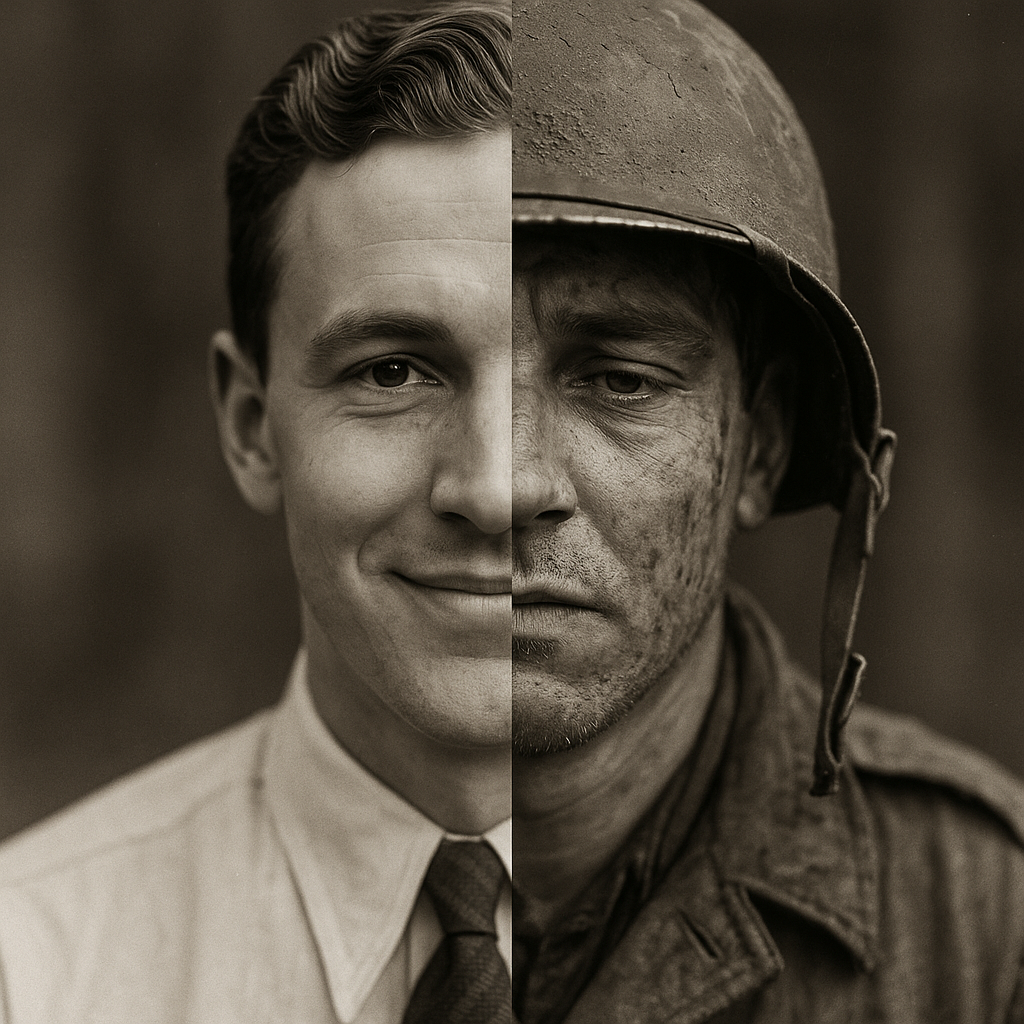
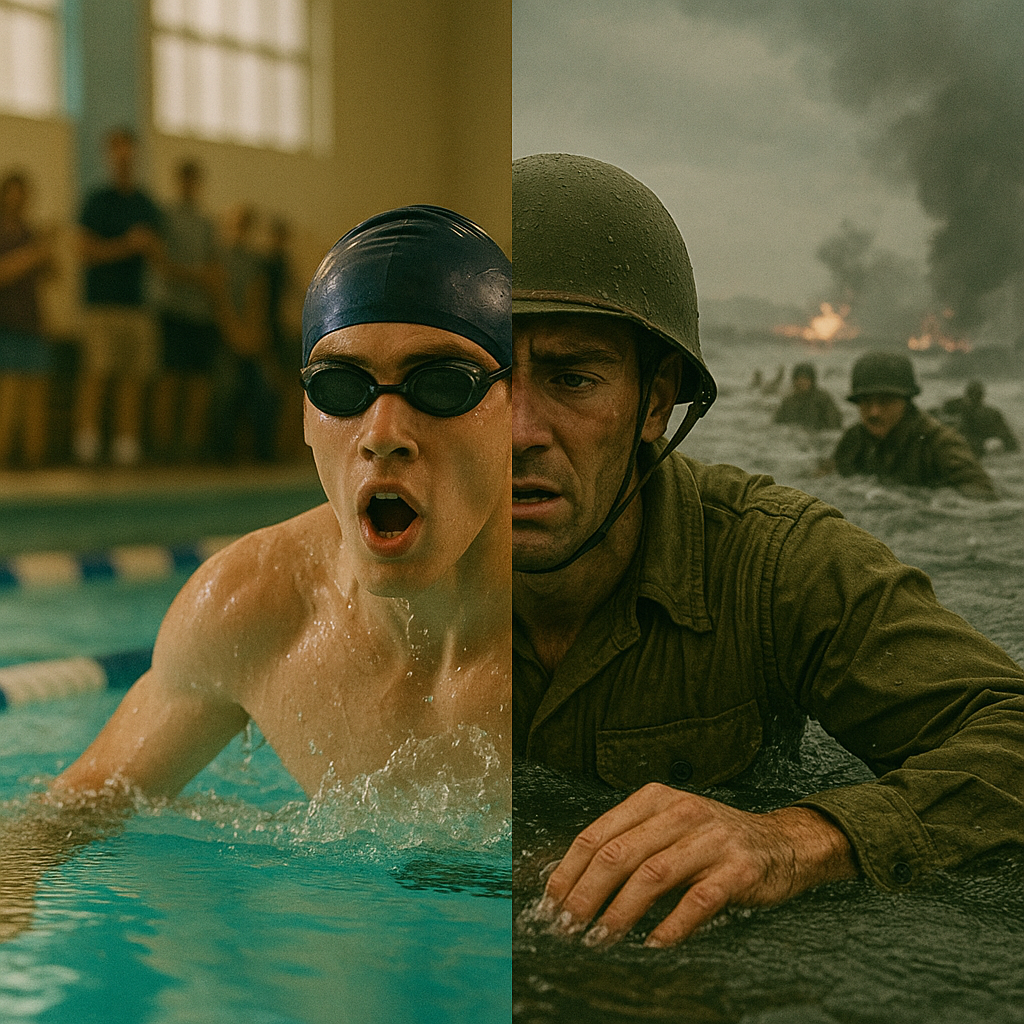
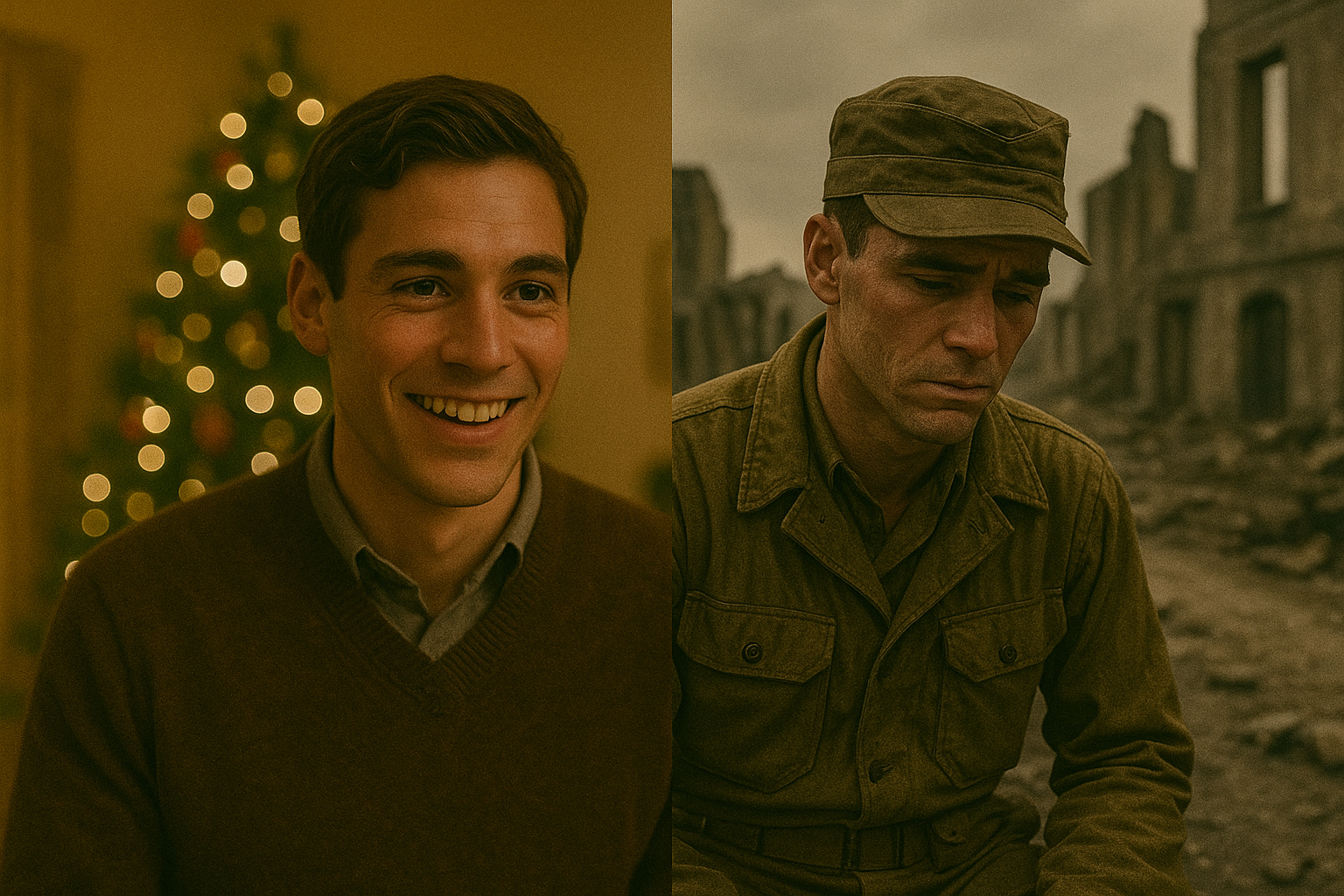
The series is built as six split images. It opens with a direct split portrait and
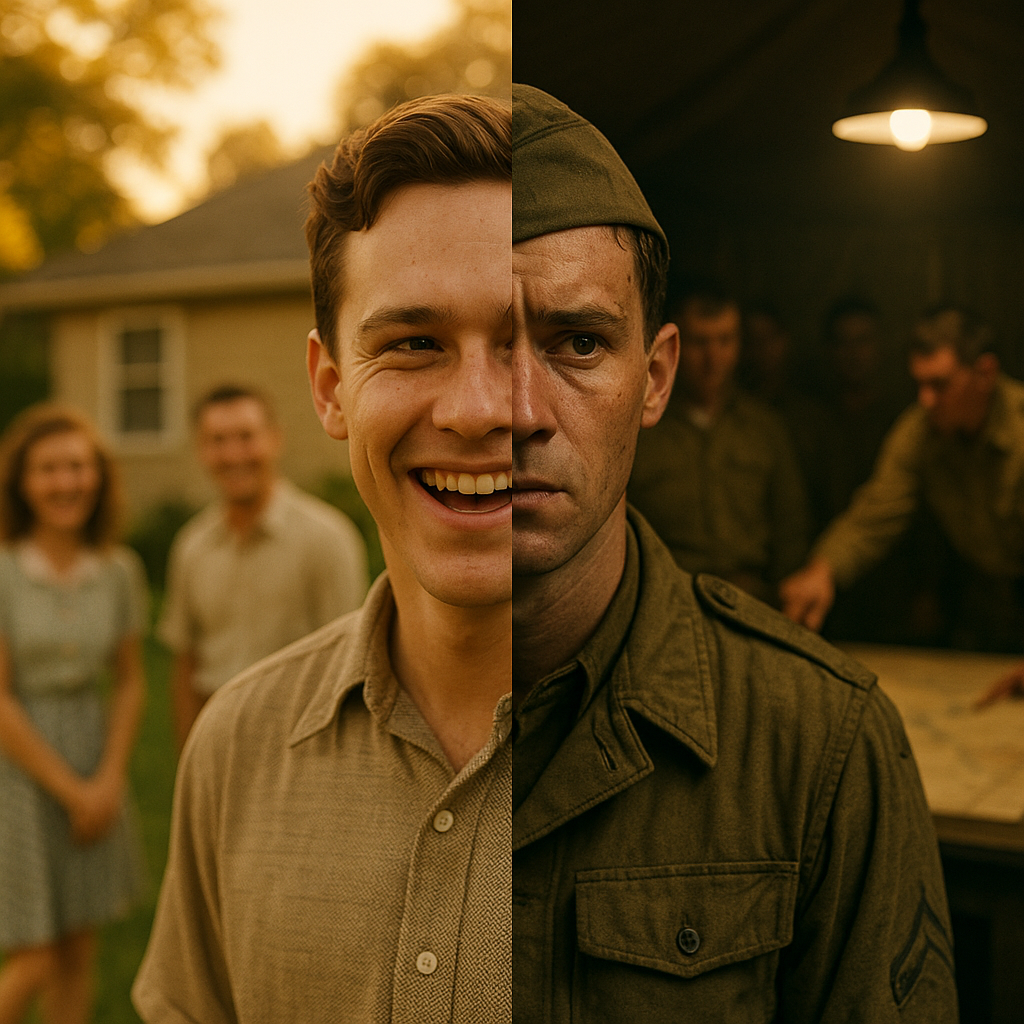
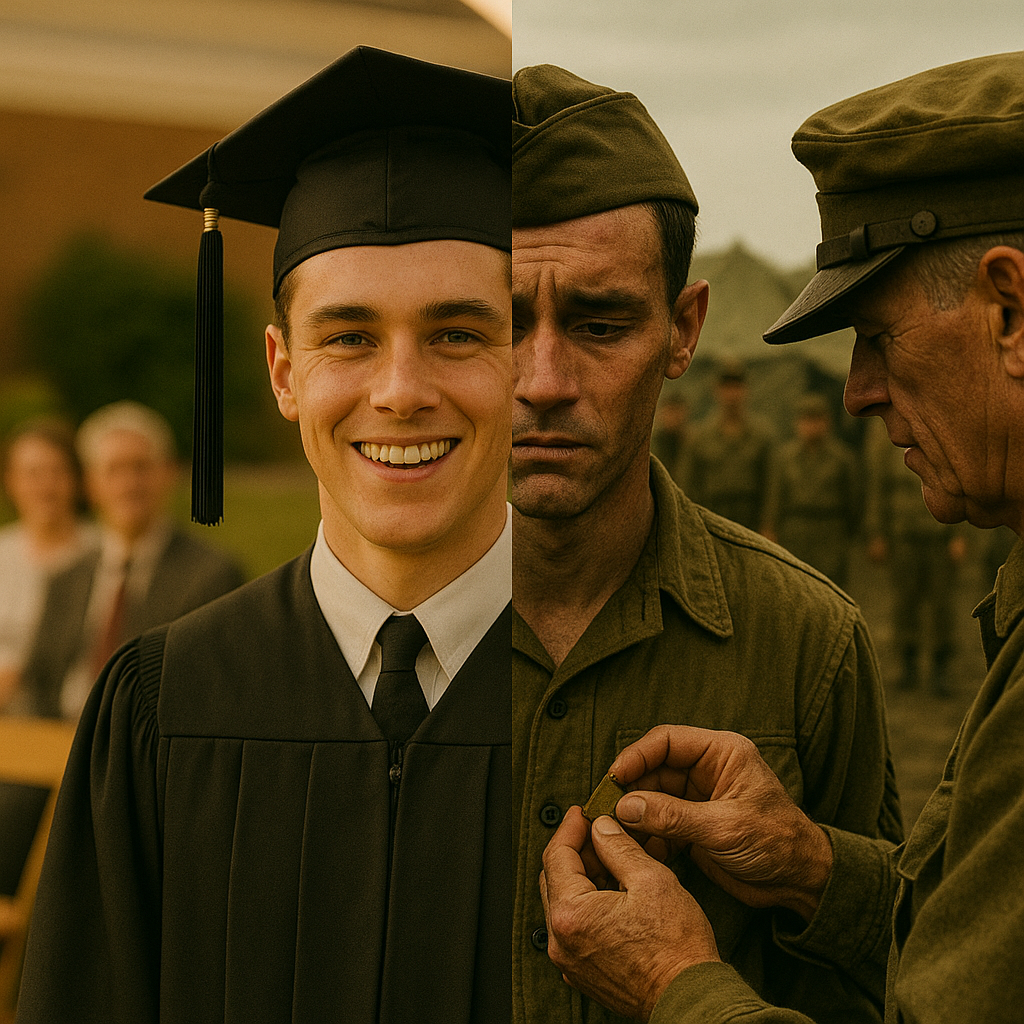
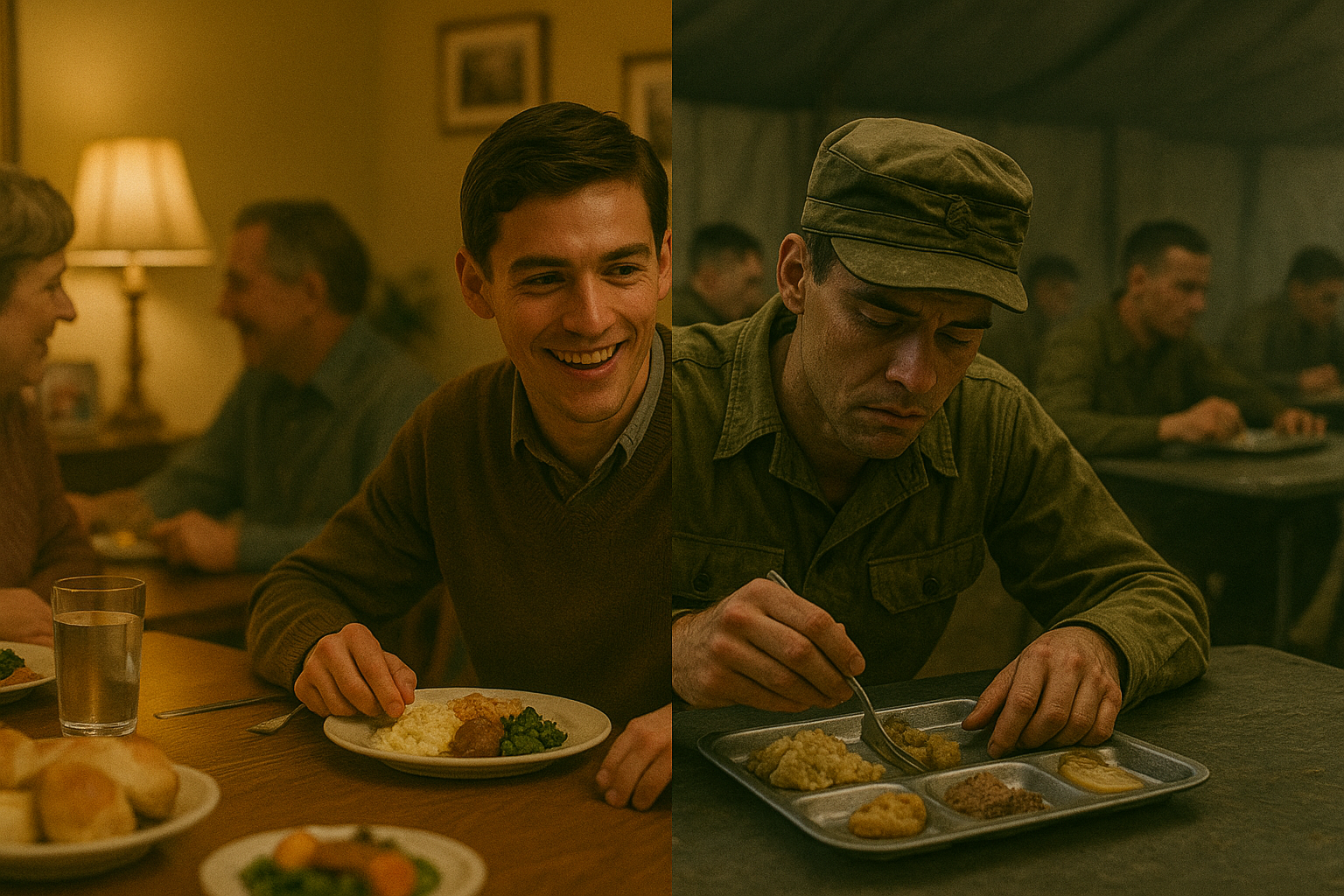
then recreates specific moments from the soldier’s “before” life, pairing each one
with a related scene from his war life: backyard versus briefing room, graduation
versus promotion, family dinner versus mess tent, swim meet versus invasion, and
Christmas at home versus ruins abroad. The left halves lean into warmth, nostalgia,
and the kind of images you’d find in a family album. The right halves shift toward
muted color, harsher light, and a body that looks older even though not much time
has passed. By repeating the same character in these mirrored situations, I wanted
the viewer to feel how quickly comfort can flip into danger, and how experiences
that look like “success” in one world feel empty or haunted in another.
My process was intentionally hybrid from the beginning. I started with written
brainstorming in my journal, sketching out different ways I could visualize
emotional disconnection and time compression. From there, I moved into AI
conversations, using ChatGPT to help me clarify the overall structure of the series
and to draft detailed prompts for each image. The idea of pairing specific
activities—like swimming or graduating—across home and war came out of that
dialogue. Instead of asking the AI to “just make a war image,” I treated it as a
collaborator that could help me find tighter visual rhymes: a stage mirrored by a
promotion ceremony, a swim lane mirrored by the sea at an invasion, a holiday
living room mirrored by a street of ruins.
Once I had the prompts, I used an image-generation model to create multiple
versions of each split scene. This part felt a lot like casting and directing. The
AI would give me faces, lighting, and compositions that were close but not quite
right. I had to choose which outputs actually supported the story I wanted to tell:
Was the soldier’s expression too heroic? Did the family side look like a stock
photo instead of something personal? Was the war half too dramatic and cinematic in
a way that made the image feel like a movie poster instead of a memory? I also paid
attention to details that the model hallucinated, like extra medals or flags, and
rejected images where those details pushed the narrative toward propaganda.
After selecting the strongest outputs, I refined them through cropping, minor
color adjustments, and sequence ordering. The goal was not to make the images look
“perfect,” but to make the emotional arc feel consistent across the series. I
wanted the viewer to notice the soldier aging emotionally—even if the time gap
between halves isn’t actually that long. In this sense, the process lines up with
the course’s idea of entangled aesthetics: the images are not just human
or just machine, but the result of negotiation. The AI suggested possible worlds in
a visual language shaped by war photography and cinema, while I acted as an editor
who pushed back against some of those defaults to keep the focus on quiet emotional
damage instead of spectacle.
Conceptually, the project is also connected to what we discussed about emotion
and simulation. These images are capable of producing a strong emotional
reaction despite being simulations of moments that never happened to a real person.
The AI has learned how “war” and “home” are supposed to look based on existing
datasets, so it can generate the right uniforms, props, and lighting. But the
emotions we feel while looking at them are coming from our own associations and the
stories we attach to those visual cues. For me, working with this system raised
questions about empathy and distance: Is it respectful to simulate trauma this way?
Can images that are technically fake still help us think more honestly about how we
glorify or sanitize war?
The process also challenged how I think about creativity and authorship. On one
hand, I wrote the prompts, chose the sequences, and made all the final decisions,
so it feels like my piece. On the other hand, the visual style, faces, and many of
the small details were invented by a model trained on images I will never see and
by artists who will never know they contributed. Instead of trying to pretend that
the work is “purely mine,” this project makes that entanglement visible. The split
down the center of each image isn’t just about home and war; it’s also about human
and machine authorship sharing the same frame. The piece doesn’t resolve that
tension, but it uses it as part of the point.
Overall, this project taught me that working with AI is less like using a brush and
more like managing a conversation—with all the misunderstandings,
compromises, and surprises that come with that. The machine is good at filling in
atmospheres and details, but it doesn’t know what matters emotionally unless I keep
steering it back to the story I want to tell. By the end, I felt less interested in
asking whether the AI’s contribution was “too much” and more interested in how we
can use these tools to make the invisible visible: the way a life can split, how
memories echo across very different spaces, and how technology is now part of how
we imagine and remember those stories.