Narrative Traditions I
To Do This Week
read: The Poetics, by Aristotle (pgs 1–60)
Journal: In Fargo, how does the plot set in motion the actions and reactions of the main characters? What do these actions reveal about the inner lives of the characters, about their flaws and transformations? Identify and describe other characteristics of a tragedy of tragic structure (from Aristotle’s Poetics) that you observe in Fargo. Quote from the text.
In Class
Discuss Fargo — dramatic structure
Discuss Aristotle’s Poetics
Notes
Fargo
Fargo Characters:
Jerry Lundegaard
Marge Gunderson
Jean Lundegaard
Shep Proudfoot
Gaear Grimsrud
Carl Showalter
Wade Gustafson
Mike Yanagita
Norm Gunderson
What is Dramatic Storytelling: Slide Talk
Notes from talk
Greek Tragedy
- began as ritual in honor of god Dionysus (tragoedia means “goat-song”)
- officially recognized in 534 BC
- ekstasis: “to be or stand outside oneself”
- contest between three playwrights over three days, sunrise to sunset
- integral with democracy, unity in difference
- tragedy — downfall of a hero/heroine by hubris, fate, or the will of gods
Aristotle Poetics, 335 BC
Socrates > Plato > Aristotle — logic, scientific inquiry and methods, classification and taxonomy, aesthetics, literary criticism
Aristotle’s Tragic Plot
- plot = “the arrangement of the incidents”
- drama vs. narration (mimesis)
- unity of action (cause and effect)
- complex plot: reversal and recognition
- catharsis: purging pity and fear
Epic — episodic, multiple plots
Comedy — characters of a “lower” type
Tragedy — characters of a “higher” type, unity of time/place
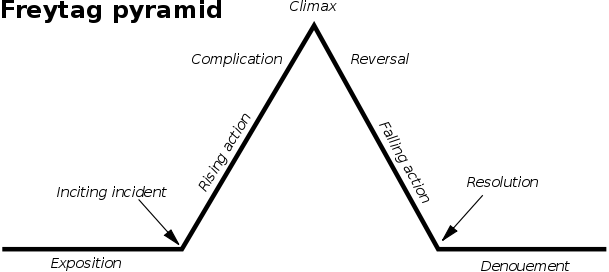
Three Act Structure
Feature Length Movie
Act 1 (20–25 min): exposition, inciting incident
Act 2 (20–60 min): complications, point of no return
Act 3 (20–25 min): unraveling, resolution
Very Short Movies (1-3 minutes)
Act 1 (10-20 sec): exposition, inciting incident
Act 2 (20–60 sec): complications, point of no return
Act 3 (10–25 sec): unraveling, resolution
Short-Short Stories
Break down events in terms of character and plot.
In-class Activity
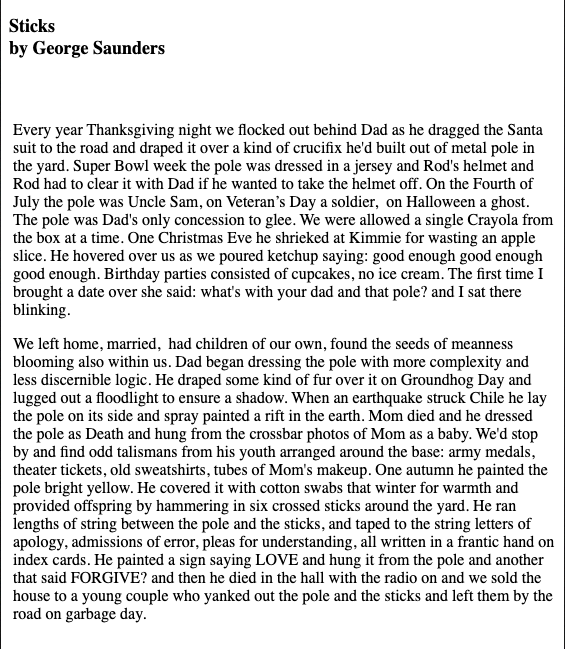
Postmodern Tragic Character (Short Short Story)
George Saunders’s “Sticks” can be read as a postmodern story with a classical tragic backbone.
- Postmodern method: minimal interiority; meaning carried by external signs, ritual, and repetition.
- Mediated culture: public symbols and holiday language replace private expression.
- Classical structure: escalation → fracture → aftermath (a recognizable domestic tragic arc).
- Tragic effect: the father’s “inner life” is legible only as patterned action, which outlives the family.
Using George Saunders’s short short “Sticks” as a model, write a very brief story in first person or third person about a tragic character.
Rules:
- Do not moralize, judge, or explain what the story “means.”
- Do not explain what the character thinks or feels.
- Just report actions the character takes, moment by moment.
- Let meaning emerge through what happens and what results.
Your story can be:
- A true story
- An altered version of something that happened
- A complete fiction
5 Story Summaries (5%): Thursday DUE Feb 5
- Personal anecdote as fiction
- Classical Aristotelian 3-part structure
- Episodic structure
- Kishōtenketsu 4-part structure
- Surrealist or fantastic mode