Narrative Traditions II
To Do This Week
watch (explore and then find two to watch more attentively):
Meshes of the Afternoon - Maya Deren (1943)
Small Deaths, Lynne Ramsay
She and Her Cat, by Makoto Shinkai
160 Characters, by Victoria Mapplebeck
Journal:
The above award-winning short films do not follow the Aristotelian plot structure. That is, they are stories that do not develop around a single, clear central conflict. How do they work? Where is the conflict or strife? What do their worlds evoke for you? Can you detect narrative patterns or structures? Reflect and compare two of the stories.
Notes
Review:
"Fargo" - event, reactions
character and plot
"Story of an Hour" - modern + classical, where is the conflict? Internal/subjective?
Event + Reaction (conflict) + Twist + Resolution
"Sticks" - postmodern + classical, where is the conflict? Selective external details.
Series of Events + implied conflict
Discuss short films...
The Golden Key
by Jacob and Wilhelm Grimm
Once in the wintertime when the snow was very deep, a poor boy had to go out and fetch wood on a sled. After he had gathered it together and loaded it, he did not want to go straight home, because he was so frozen, but instead to make a fire and warm himself a little first. So he scraped the snow away, and while he was thus clearing the ground he found a small golden key.
Now he believed that where there was a key, there must also be a lock, so he dug in the ground and found a little iron chest. "If only the key fits!" he thought. "Certainly there are valuable things in the chest." He looked, but there was no keyhole.
Finally he found one, but it was so small that it could scarcely be seen. He tried the key, and fortunately it fit. Then he turned it once. He turned twice. And another time and now we must wait until he has finished unlocking it and has opened the lid.
Then we shall find out what kind of wonderful things there were in the little chest.
Non-Western Narrative Traditions
Slide Presentation
- Non-Western (non-Aristotelian) storytelling - less conflict, more fractal patterns, episodic
- Modern, Avant-garde, Experimental - surrealist, irrational, fragmented, broken causal/chains, dissonance, abstraction, chance
- Post-Modern - metafiction, collage, remix, stories within stories
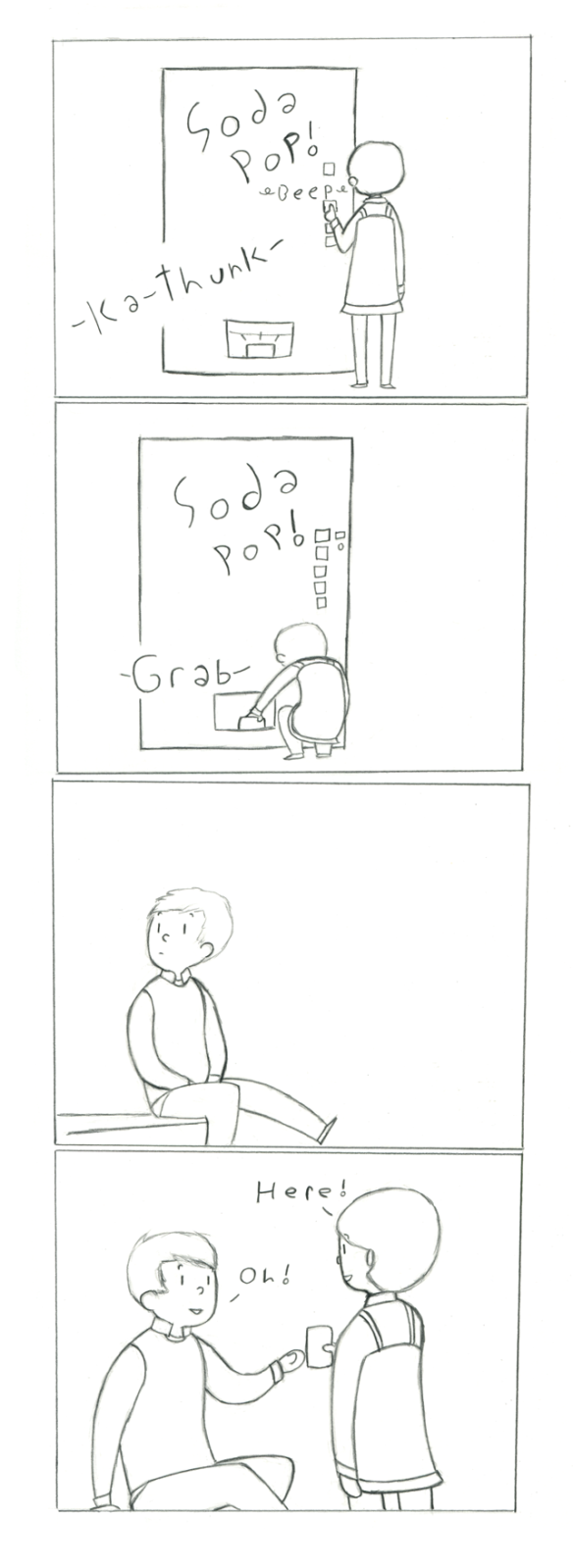
Kishōtenketsu - Japanese story form (from China)
Ki: the introduction: setting, characters, situation, relationships
Shō: further development, following the introduction. no big changes
Ten: a pivot or twist to another topic, character, situation, setting. this can be jarring, but doesn't have to be
Ketsu: ending, it wraps up the story by uniting the first two parts with the third, the twist, making the parts a whole.
the-significance-of-plot-without-conflict
Yonkoma: 4-paneled manga
Experimental narrative: dada, surrealism, improvisational, anti-narrative
Writing with AI Workshop
You are not required to use AI in this class, but I encourage you to do so, at least to see what it is.
Water & Energy Concerns
Energy Per Hour (Active Use)
- Netflix (HD video): ~250 Wh/hour
- YouTube (HD video): ~200–300 Wh/hour
- Gaming (console/PC): ~200 Wh/hour
- Podcast (audio): ~2–10 Wh/hour
- Reading articles: ~1–10 Wh/hour
- ChatGPT (writing pace): ~1–2 Wh/hour
Cooling Water Per Hour (Active Use)
- Netflix (HD video): ~20–60 mL/hour
- YouTube (HD video): ~10–50 mL/hour
- Gaming (online): ~5–20 mL/hour
- Podcast (audio): ~0.5–3 mL/hour
- Reading articles: ~0.2–2 mL/hour
- ChatGPT (writing pace): ~0.5–5 mL/hour
In-Class Exercises
Always begin in your journal, not with AI. Write from your own memory, anecdote, observation, dream, or imagined situation. This human material is the core of your story and should be protected. Do not ask AI to generate the emotional center, the conflict, or the meaning of your work. The exercises below are meant to open options, suggest directions, and provide structure, not to replace your instincts or your voice.
Take a few minutes to write in your journal some thoughts about a story or world you would like to work on in this class. Where and when does it take place? What is the world like? What kind of characters are in this world?
Storyworlds
This exercise will take you through steps to building material for your stories. Use ChatGPT or Claude to design a world around a small group of fictional characters. AI is used here to help develop context and specificity, not to invent the story itself.
- Begin a Chat with some of the ideas for your world. When and where is it? It it a particular time in history or in the distand past or far in the future?
- Develop the details of the world. Your story can be in a small and limited microcosm, or a vast world. What details can be brought into your story? Explore its economic, cultural, political, climate, or ecological conditions.
- Ask for additional factual or contextual details that help the world feel concrete.
Characters
Next, use AI to generate options and variations for character, while keeping the inner life of each character your own.
- Prompt for character names, ages, occupations, and public-facing background details.
- Ask for constraints that shape each character’s life (work, money, family, health, reputation).
- Separately, note in your journal (without AI) what each character wants, fears, and avoids admitting. Are they protagonists and antagonists, or just a group of friends? Is there a single character the emerges as a main focus of the story?
- Back in a chat, explore these ideas of the characters' inner lives. Where do you see a potential for a story?
Dialogue
Use AI to explore how characters might speak, not to write finished scenes or emotional exchanges.
- Prompt for common terms, phrases, or jargon related to a character’s profession, expertise, or social role.
- Ask for examples of how the same idea might be expressed in different registers (formal, casual, guarded).
- Role-play with AI a potential dialogue scene.
- Write your own dialogue using selected terms, focusing on rhythm, tension, and subtext.
- Remove anything that sounds generic or overly polished.
Plot Feedback
Use AI as a mirror for structure and pacing, not as a source of story events.
- Write in your journal a short list of major story events in plain language.
- Ask AI to comment on pacing, order, or clarity.
- Experiment with reordering events based on feedback.
- Get help from AI in developing a more developed plot that works for you.
- AlWAYS decide which suggestions support your instincts and which to discard. May attention to your intuition.
Create a Summary
In journal, quickly write/sketch your story idea. Focus on events and character.
Enter a summary paragraph in a chat. Ask for a critical evaluation of the plot and character change.
Assignment: 5 Story Summaries (5%)
DUE: February 7th
Write 5 short-story summaries (200-300 words) within the 5 genre/styles from the list below. These will be projects you might like to pursue as digital stories in this class. Share as a doc or Google Doc (allow sharing) in Slack and submit doc in Canvas.
- Personal anecdote as fiction
- Classical Aristotelian 3-part structure
- Episodic structure
- Kishōtenketsu 4-part structure
- Surrealist or fantastic mode
Writing Your Summaries
- focus on plot: what are the main events and who are the main characters
- these are shorts, so plots should focus on one central event
- summaries are not the telling of stories, they are blueprints for developing into stories
- ideas for stories can come from anywhere - from other stories, from memory, from dreams and the imagination. let your mind wander
- Episodic summaries should focus on the main theme that are shared by each of the mini stories. For example, a theme of growing old from the perspectives of a child, an adult and elderly person, and then describe each of the episode plots.
- Surrealist, fragmented and dream story summaries need only describe a situation or main idea. These forms are playful, imaginative or psychological - but that can develop into more structured stories
- The personal anecdote summary is intended for you to shape a plot out of a personal experience. You may need to change things around a bit to make the anecdote work as a story