Week 2 - Sculpting Space
To Do For This Week
Assignment: One Day in 30 Seconds (5%)
Using your smartphone in HORIZONTAL mode, record your experience of one day in short 2 to 6-second shots.
- Capture various types of images and sounds, in different shot positions (close-up, medium, long-shot) and in various locations (home, with friends, commute, job, errands, campus).
- Take many shots throughout the day and include only 30% of these in your final video.
- Make visual, auditory, or metaphorical connections from shot to shot. For example: a coffee cup on a table, a sunset, walking down a crowded hall, or a close-up of a video game screen.
- Edit your shots in Premiere to create a 30 second video. Export using the format .H264 with a preset of YouTube or Vimeo at 720p. Upload to YouTube or Vimeo and post to the blog - just paste the url onto its own line.
This assignment focuses on using various framed shots (close-up, medium, long) to create a montage of one day in your life – morning to night – this week. You may use text if desired, but no music or voiceovers. Use only the sound you capture in the shot. The video should reflect your perspective, so avoid selfies. While parts of yourself can appear, do not include direct shots of you staring at the camera.
In Class
Notes
Adobe Premiere
Shooting Settings:
- Set phones and cameras to HD 720p or 1080p resolution.
- Always shoot in horizontal or landscape mode!
Exporting Settings:
- Export in codec .H.264 and format .mp4.
- Use presets for YouTube or Vimeo.
Watch:
30-second-day videos...spatial and temporal discontinuity (montage)- read as continuous.
Run Lola Run
Building Blocks of Cinematic Storytelling
- Framing: Distance from subject, angle, diagonal lines, depth, light/shadow, focus, rule of thirds, moving frame, duration.
- Continuity Editing: Motivated shots, screen direction, 180-degree rule, match on action, graphic match, eye-line match, POV.
- Montage: Juxtaposition of discontinuous shots, rhythm, temporal shifts, dreams, ideas, and associational thinking.
- Mise-en-scène / Production Design: All elements captured by the camera: set design, costume, makeup, actor movements, and expressions.
The Classical Hollywood Style
- Individual Characters: Causal agents driving the story.
- Desire: The protagonist's desire initiates the plot and defines the goal.
- Opposition: Conflict against the goal.
- Cause and Effect: Events shown only when relevant to the causal chain.
- Objectivity: Omniscient point of view with unrestricted access to events.
- Closure: No loose ends.
Run Lola Run's Style
- Time and narrative: Chains of cause and effect, reinforced by continuity.
- Hypertext aesthetics: Bifurcations, loops, digressions.
- Mixed media: Black and white, color, animation, film, and video.
- Spatial techniques: Orient the viewer in a fragmented temporality.
- Post-classical continuity: Faster cutting, tighter close-ups, free camera movement.
- Stretching/compressing time: Screen time vs story time.
Video Game Aesthetics
- 360-degree spin shots.
- Short still-frame montages.
- Character goals and countdowns.
- Respawning, game strategies, flashbacks, flashforwards.
- Temporal loops and multi-linearity.
Editing
Rules of Continuity
- Establishing shot
- 180-degree rule
- 30-degree rule
- Match on action
- Motivated POV shot
- Eyeline match
- Parallel action/crosscutting
Elements of Montage
- Spatial fragmentation
- Associative cuts
- Metric edi
- Rhythmic editing
- Directional tension
- Ellipsis (gaps)
- Sound bridges
- Graphic matches or contrasts
- Psychological continuity
Time, narrative and editing...
Structure of looped time:
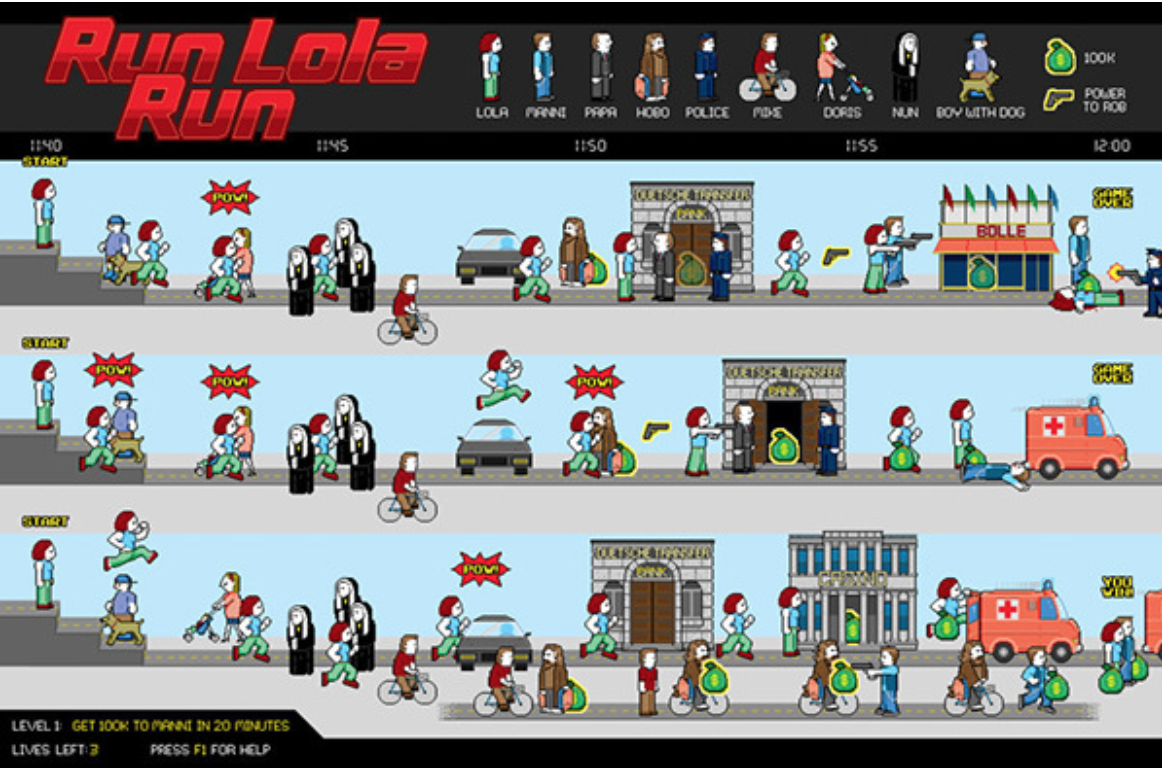
Backstory Scene - Black and White, Narration
Roulette - tension
10-second Montages
Sculpting Cinematic Space
Muskateers of Pig Alley - D.W. Griffith (1912)
Space as social pressure: Bounded space, depth, diagonals, bodies guiding attention. The street acts on behavior.
Man with a Movie Camera (1929), Dziga Vertov
Space as rhythmic system: City symphony, stillness/movement, city waking up.
Tokyo Story (1953) - Yasujiro Ozu
Space as containment and duration: Boxed interiors, empty frames, thresholds. Space persists beyond action.
Meshes of the Afternoon - Maya Deren (1943)
Space as psychological and symbolic logic: Thresholds, repetition, impossible continuity. Space obeys dream rules.
The Shining, Stanley Kubrick
Space as imposing architecture: Scale, symmetry, control. The building dominates the human figure.
Pi, Darren Aronofsky
Space as mental information field: Fragmentation, proximity, montage. Space collapses into cognition.
160 Characters, by Victoria Mapplebeck
Information Space: Everyday movement, layered text, and lived environments. Mobile phone consciousness.
In-Class Group Exercise: Space as Character (Night Campus)
In groups of 2–3, film a short sequence on campus (indoor and/or outdoor). Your goal is to treat the space as a character. Use framing and sound to reveal what the space feels like (open or constricted, calm or tense, welcoming or hostile) and how it shapes attention and movement.
Include a simple character situation: one or two student still on campus (studying, walking, searching, waiting, leaving). No dialogue needed. The story should be carried by space, movement, and sound.
Guidelines
- Shoot a sequence of 5–10 shots in landscape (mix shot scales).
- Record original sound and use it to define space (hums, echoes, footsteps, wind, doors).
- Use framing to reveal character in the space (doorways, thresholds, depth, offscreen areas).
- Each student will edit individually from the group’s footage (20-30 seconds).
- Share on Slack
Sculpting Space (5%) DUE: Feb 23
In this project, you will treat space as an active presence—almost as a character—rather than a neutral backdrop. Through framing, camera movement, editing, and sound, you will reveal how a space feels, how it shapes behavior, and how it directs attention over time. Instead of recording a location from a single viewpoint, you will construct it cinematically, allowing the viewer to experience its openness or confinement, its clarity or confusion, and its psychological or narrative pressure.
The space may feel welcoming or hostile, expansive or constricted, calm or tense. What matters is not what the space “is,” but how it is revealed—where the eye is drawn, what changes within the frame, and how movement and sound guide the viewer through it. By the end, the viewer should have a clear sense of how this space operates and what it does to those inside it.
Requirements
- Final video length: 60 seconds max
- Shoot in landscape (horizontal) orientation
- Use a range of shot scales: long shots, medium shots, close-ups
- Define a space through framing, movement, editing, and sound
- Use sound that you record yourself
- Upload to YouTube or Vimeo and post to Slack and submit to Canvas
Suggestions
- Think of the space as having a personality: is it open, constricted, orderly, chaotic, isolating, or disorienting?
- Use a moving subject to reveal the space—someone walking, searching, waiting, or passing through can guide both framing and editing
- Let changes in movement, direction, or pace suggest where to cut and what the viewer should notice
- Pay attention to where the eye goes within each shot: toward motion, depth, light, or offscreen cues
- Use sound to shape the space: footsteps, movement, room tone, distant voices, wind, or mechanical noise can suggest scale, distance, and unseen areas
- Record sounds separately if needed, and allow them to bridge cuts or suggest spaces beyond the frame
- Ask yourself: Does the space feel open or constrained? How does it affect movement, attention, or mood?
Project Ideas
- Space as Documentary: A short observational portrait of a place such as a farmers market, campus, workshop, gym, or transit stop. Use framing, movement, and sound to reveal how the space functions, where attention flows, and how people move through it. Avoid interviews or explanation—let the space speak through activity and rhythm.
- Space as Experience (Subjective POV): A short film experienced from a single point of view, as if we are inside someone’s perception. Use camera movement, framing, and sound to shape how the space feels—open or claustrophobic, calm or anxious, familiar or strange. The story is not what happens, but how the space is encountered.
- Space as Character (Fictional Scene): Create a simple fictional situation where the location is the dominant force. A person enters, waits, searches, or leaves. The space should influence mood, movement, and attention more than action or dialogue.
- Transition Through Space: A short sequence focused on moving from one area to another—inside to outside, public to private, light to dark. Use cutting, sound, and camera position to make the transition meaningful. The emphasis is on how spaces connect, not on arriving at a destination.
- Empty Space, Traces of Use: Film a space with little or no human presence. Use framing, sound, and duration to suggest recent or imminent activity. The absence of people should make the space feel inhabited rather than dead.
- Compressed or Fragmented Space: Use close-ups, partial views, and sound to construct a space without ever showing it fully. Let the viewer assemble the space mentally through fragments.