 07
DTC 101
07
DTC 101
Artificial Intelligence
Artificial intelligence is a broad term for computer systems that perform tasks associated with human intelligence, such as recognizing patterns, classifying information, making predictions, generating language, producing images, or helping people make decisions. AI systems do not work like human minds, but they can imitate some of the outward signs of intelligence because they are built from data, computation, and statistical patterns.
This chapter introduces artificial intelligence as both a technical system and a cultural force. It follows the earlier chapters on digital technology, media, networks, social platforms, and data because AI is made from all of these. AI depends on hardware and software, large collections of data, networked platforms, and the cultural habits of people who produce and share images, text, sounds, and code.
The goal of this chapter is not to turn you into a computer scientist. Instead, it gives you a practical and critical vocabulary for understanding how AI works, what it can and cannot do, and how it is changing writing, art, research, work, entertainment, and everyday communication.
7.1
A Brief History of AI
The dream of artificial intelligence is older than computers. Myths, automata, mechanical calculators, puppets, and fictional robots all express a desire to create artificial beings or intelligent tools. During the twentieth century, this dream became connected to computing. Once information could be represented as code, researchers began asking whether reasoning, language, perception, and creativity could also be represented as computational processes.
Early AI research often focused on symbolic AI, sometimes called Good Old-Fashioned AI or GOFAI. These systems attempted to model intelligence through explicit rules, logic, and symbolic representations. If a computer could be given enough rules, perhaps it could solve problems in ways that resembled human reasoning.
In 1950, Alan Turing proposed what became known as the Turing Test, asking whether a machine could imitate human conversation well enough that a person could not reliably distinguish it from another human. Early AI researchers believed that intelligence could be recreated through carefully designed rules and logical reasoning. These symbolic systems performed well in limited domains but struggled with the ambiguity and complexity of everyday life.
ELIZA
ELIZA was an early program created in the 1960s by Joseph Weizenbaum. It mimicked a conversation with a therapist using simple pattern matching. While it could simulate conversation, it did not understand the meaning behind the words. ELIZA showed both the promise and the limits of early symbolic AI.
ELIZA: natural language processing program by Joseph Weizenbaum
By the 1990s and 2000s, growing computing power, larger datasets, and improved algorithms shifted AI research toward machine learning. In machine learning, computers are not programmed with every rule in advance. Instead, they are trained on examples. Rather than telling the computer exactly how to identify a cat, translate a sentence, or recommend a video, machine learning systems look for statistical patterns in large collections of data.
Some important milestones in this shift include:
- 1950 – Alan Turing proposes the Turing Test.
- 1966 – ELIZA demonstrates conversational pattern matching.
- 1997 – IBM's Deep Blue defeats world chess champion Garry Kasparov.
- 2012 – AlexNet dramatically improves image recognition using deep neural networks.
- 2016 – DeepMind's AlphaGo defeats world champion Lee Sedol using deep learning and reinforcement learning.
- 2017 – Google researchers introduce the Transformer architecture, which becomes the foundation for modern large language models.
- 2022 – OpenAI releases ChatGPT, which reaches an estimated 100 million users within about two months.
AlphaGo
AlphaGo showed that AI could master a game of deep strategy and intuition. It learned not only from rules, but from examples, self-play, and reinforcement learning. Its victory over Lee Sedol in 2016 became a turning point in public understanding of AI because the system made moves that surprised even expert human players.
AlphaGo: The Movie, Google DeepMind
From Rules to Patterns
The history of AI can be understood as a movement from rules to patterns. Rule-based systems work well when the world can be clearly described in advance. Pattern-based systems excel when the world is complex, ambiguous, and too variable to describe with explicit rules. Contemporary AI depends on this pattern-based approach.
“What we want is a machine that can learn from experience.”
— Alan Turing, lecture to the London Mathematical Society (1947)
For students of digital technology and culture, the important question is not only whether AI is intelligent, but what kinds of human activities are being translated into data, prediction, automation, and generation. The next section looks at how the pattern-based approach actually works.
7.2
Machine Learning and Neural Networks
Machine learning allows computers to improve their performance by learning from examples rather than following a fixed set of rules. Instead of programming every possible situation, developers train a system using many examples so it can recognize patterns and make predictions about new data.
Image recognition provides a familiar example. Rather than telling a computer exactly how to identify a face, tree, or stop sign, a machine learning system is trained on thousands or millions of labeled images. Over time, it learns statistical patterns that allow it to recognize similar images it has never seen before.
Training, Models, and Neural Networks
In AI, a model is the result of the training process. During training, the model repeatedly compares its predictions with known answers and gradually improves its performance. Rather than storing a simple collection of facts, the model learns relationships among patterns in the training data.
Most contemporary AI systems use neural networks. Although inspired by the organization of neurons in the brain, neural networks are mathematical systems made up of layers of connected nodes. Each connection has a numerical weight that represents its importance. As the network trains, these weights are continually adjusted so that the model makes increasingly accurate predictions. This process of gradually reducing error is what allows the network to learn.
Neural Networks: a short introduction
- Training data provides examples.
- The model makes a prediction.
- The prediction is compared with the correct answer.
- The network adjusts its internal weights to reduce error, a process called backpropagation.
- After many repetitions, the model becomes increasingly accurate.
The learning process can be visualized as the wearing of paths through a landscape. The demonstration below represents a small neural network as a field of possible connections between input words and output words. Each connection is drawn as a line, and its thickness represents the strength—or weight—of that connection. At first, every path is nearly equal. As the model trains, some paths become stronger while others fade away, gradually revealing the patterns the network has learned. Although real language models are vastly more complex and use mechanisms such as attention (introduced in Section 7.3), the underlying idea remains the same: learning consists of strengthening useful pathways while weakening less useful ones.
Interactive Demonstration: The Worn Path
A small neural network shown as a field of connections. Run a forward pass to send a signal through the network, then "backpropagate" to adjust the weights. Repeat the cycle and the deepest paths from input to output will emerge. The network's task is to predict the word mat from the input the cat sat.
loss–
prediction–
targetmat
steps0
Untrained. The field is unmarked.
signal moving forward error moving backward channel depth (the weights)
In an actual model, the patterns are discovered by the training process rather than set in advance. Once the channels are carved, the weights freeze, and every later use of the model is a forward pass through a fixed landscape.
A trained model is not a memory store but a landscape of channels worn by repeated training. When the model is asked to produce a result, the signal follows the deepest channels available. For a familiar or generic request, those channels lead to the most expected output, which is one reason why bland prompts tend to produce bland responses.
Machine Vision
Machine vision is the branch of AI that enables computers to interpret photographs and video. It was one of the first areas where deep neural networks dramatically outperformed earlier AI techniques. In 2012, a system called AlexNet showed that a deep neural network could classify photographs far more accurately than previous methods, reshaping AI research almost overnight. Within a few years, similar techniques powered face recognition, photo search, medical image analysis, manufacturing inspection, and the perception systems used by autonomous vehicles.
The process resembles the wearing of paths through a landscape. A neural network trained on millions of labeled images gradually strengthens connections that detect increasingly complex visual patterns. Early layers respond to simple edges and colors, later layers recognize textures and shapes, and deeper layers respond to complete objects such as faces, bicycles, or stop signs. Rather than being explicitly programmed with these concepts, the network learns them through repeated exposure to examples.
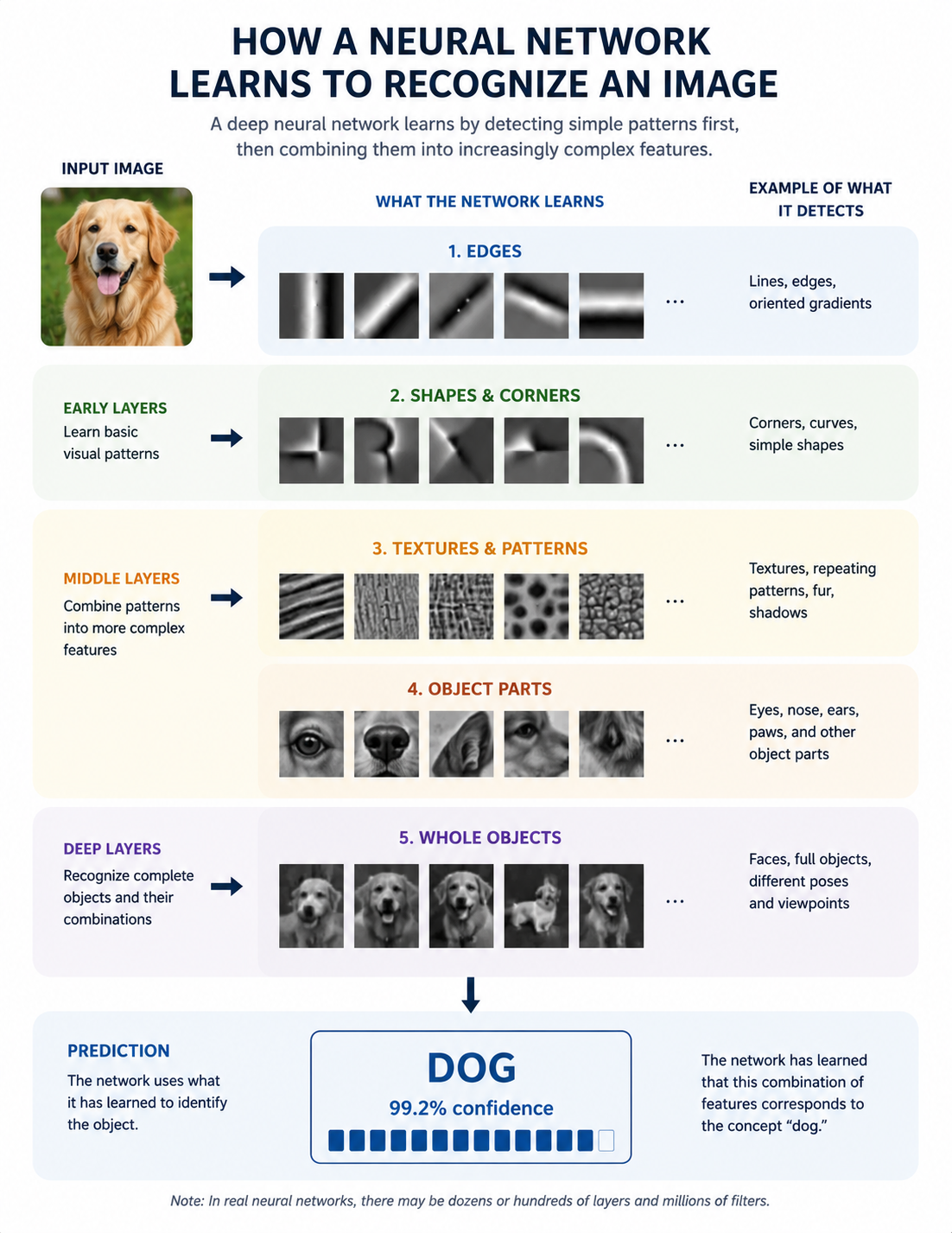
Graphic generated by ChatGPT according to author specifications. Click the image to open it full size.
Machine vision also reminds us that AI learns from human-created datasets. If the training images reflect social biases, unequal representation, or labeling errors, the model can reproduce those patterns. The same system that accurately recognizes one face may perform poorly on another, demonstrating that the quality and diversity of training data are as important as the algorithm itself. Joy Buolamwini's research on facial recognition, discussed in Chapter 06, shows how this plays out in practice. Chapter 06 also looks at ImageNet, the dataset behind AlexNet, and how its categories were chosen.
7.3
Large Language Models
The worn-path picture from Section 7.2 applies not only to images, but also to sounds, code, and language. When the same pattern-learning machinery is trained on enormous collections of digital text, the result is a large language model (LLM). LLMs generate language by predicting likely sequences of word-parts, called tokens. A token may be a whole word, part of a word, a punctuation mark, or another small unit of text.
When you type a prompt into a chatbot, the model does not look up a fixed answer in a database. Instead, it predicts which token is most likely to come next, given the prompt, the conversation so far, and the statistical patterns learned during training. It generates one token, adds it to the response, and then repeats the same process again. A complete response is simply this prediction repeated, one token after another, until the model decides to stop.
How Large Language Models Work
Next-Token Prediction
The phrase next-token prediction sounds simple, but when it is performed by a very large model trained on enormous amounts of language, it can produce surprisingly capable results. LLMs can summarize, translate, explain, imitate genres, write code, brainstorm ideas, and carry on dialogue because human language already contains patterns of reasoning, instruction, style, and knowledge. The model is not reasoning in the same way a person does. It is continuing patterns of writing in which other people reasoned.
One surprising discovery is that sufficiently large language models develop abilities that were never explicitly programmed. Researchers call these emergent behaviors. As models become larger and are trained on more diverse data, they may acquire new capabilities such as translation, summarization, coding, or simple forms of reasoning. These abilities emerge from learning statistical patterns across language rather than from separate software modules designed for each task.
Not all researchers agree that these abilities appear suddenly. Some argue that "emergence" depends partly on how abilities are measured, and that models improve more gradually than the term suggests. The debate is a useful reminder that how we test AI shapes what we think it can do.
“A stochastic parrot is a system for haphazardly stitching together sequences of linguistic forms it has observed in its vast training data.”
— Emily M. Bender, Timnit Gebru, Angelina McMillan-Major & Margaret Mitchell, On the Dangers of Stochastic Parrots (2021)
This metaphor reminds us that fluent language is not the same as understanding. LLMs can help people write, learn, code, organize information, and explore ideas. They can also produce convincing falsehoods, flatten personal style, imitate authority, and obscure the difference between knowledge and plausible-sounding language. The same statistical machinery produces both fluent truths and fluent errors.
When an AI system produces something that sounds correct but is false or invented, such as a fake citation, a made-up quotation, or a confident wrong answer, it is often called a hallucination. Hallucinations are not glitches that occasionally interrupt a reliable system. They come from the same process that produces correct answers: predicting what plausible text looks like, whether or not it is true.
Transformers and Attention
Most contemporary LLMs are built on a machine learning architecture called the transformer, introduced in the influential 2017 paper Attention Is All You Need. A transformer uses a process called attention to weigh the relationships among tokens in a sequence. Rather than processing one word at a time, it considers how all of the tokens in the input relate to one another, allowing the model to track meaning across long passages and respond to context.
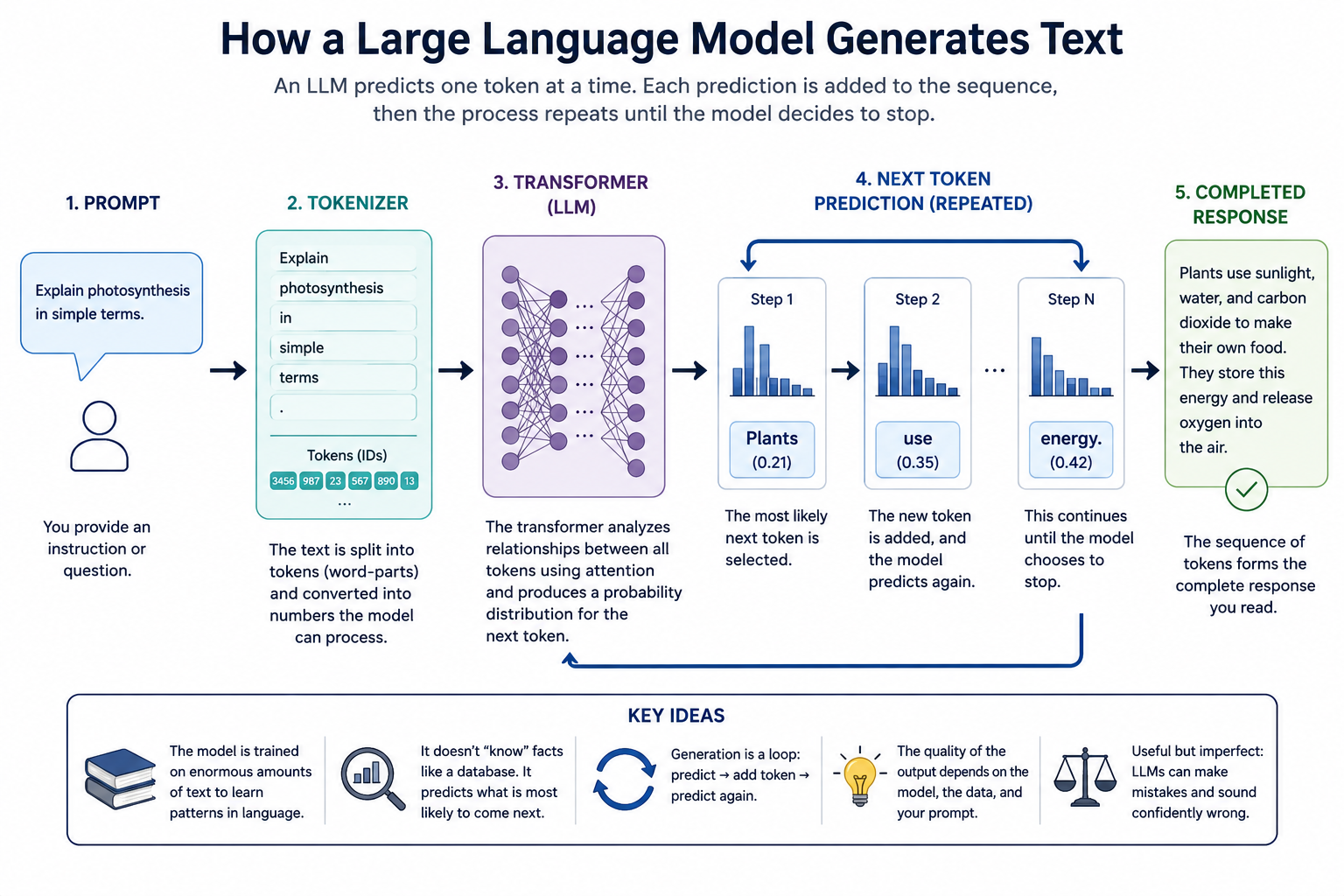
Graphic generated by ChatGPT according to author specifications. Click the image to open it full size.
The same architecture can be adapted to many kinds of data. With appropriate training, transformers power today's leading systems for language (GPT), audio (Whisper), image recognition, video, and code, and transformer components are now built into many image generators as well. This shared architecture is one reason contemporary AI is increasingly described as multimodal, able to work across text, images, sound, and video.
For this course, the key idea is that LLMs are cultural technologies built from language. They do not simply process information. They process the accumulated traces of human writing, conversation, documentation, argument, imagination, and error. The next section turns to a different application of the same pattern-based approach, this time applied to images rather than words.
7.4
Image Generation and Diffusion Models
Where large language models generate text by continuing patterns in language, diffusion models generate images by learning patterns in visual data. During training, the model learns how to gradually transform real images into random noise. It then learns the reverse process: how to remove that noise step by step until a recognizable image appears. When you enter a prompt, the model begins with random noise and repeatedly removes it, gradually producing an image that matches the prompt.
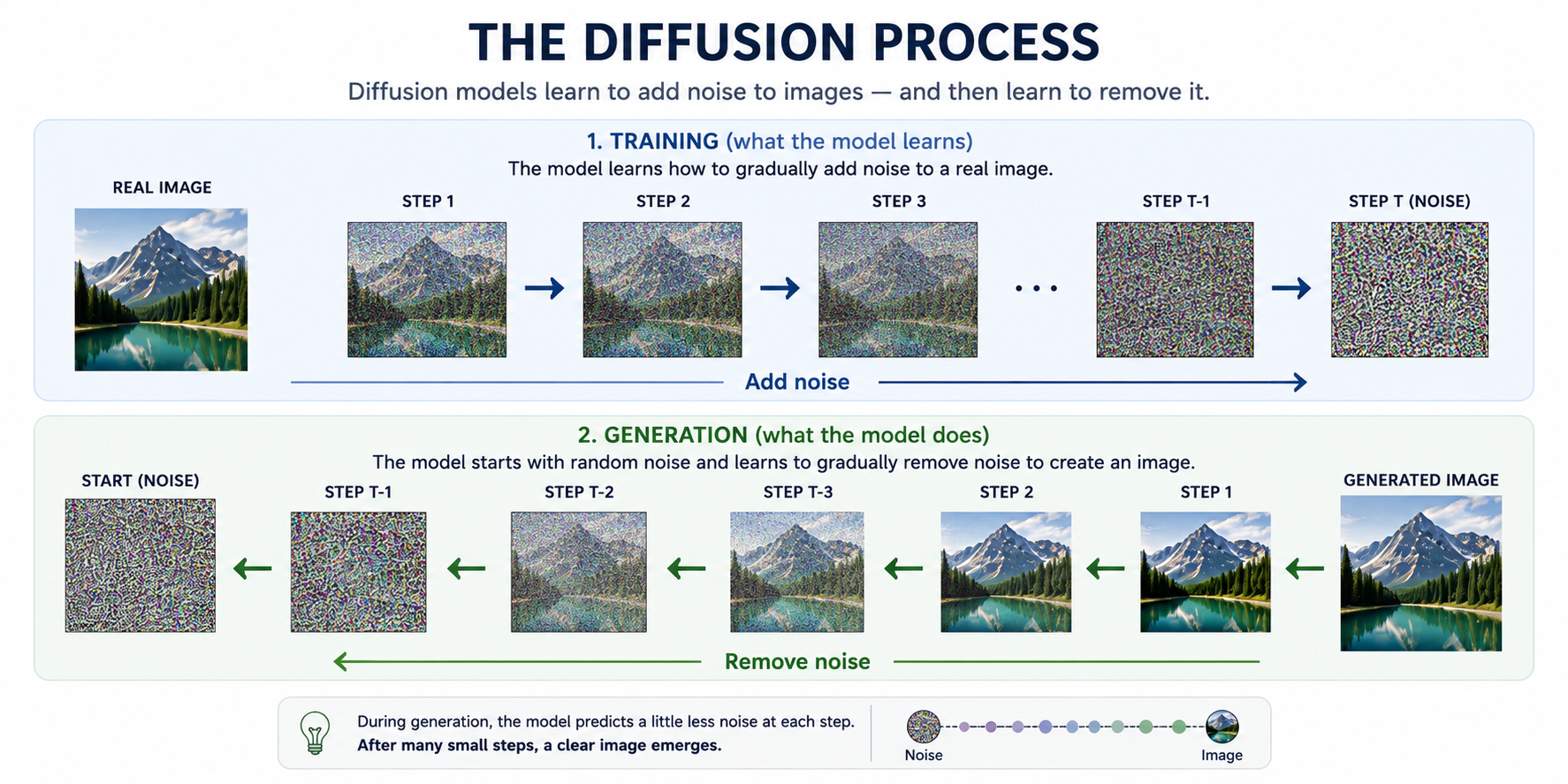
Graphic generated by ChatGPT according to author specifications. Click the image to open it full size.
Unlike a camera, which records light from the world, or a paint program, which places pixels directly onto a canvas, a diffusion model synthesizes an image from learned statistical relationships among objects, colors, textures, styles, and text descriptions. The model does not retrieve an existing image from memory. It generates a new one by navigating patterns learned from millions of training examples.
AssemblyAI: Diffusion Models Explained in Four Levels of Difficulty
Latent Space
Many generative AI systems operate within a latent space, a mathematical space built from vectors. A vector is simply a list of numbers that describes the features of an object. For example, an animal might be represented by values such as size, speed, habitat, diet, friendliness, or whether it is a predator. Each feature becomes one dimension of a much larger mathematical space. Real AI models may represent an image or a word using hundreds or even thousands of numerical dimensions rather than just a few.
During training, the model learns where images, words, styles, and concepts belong within this multidimensional space. Ideas that seem very different to people may end up close together because they share many underlying features. A text prompt guides the model toward a region of this latent space, where it gradually transforms noise into an image that best matches the requested concepts.
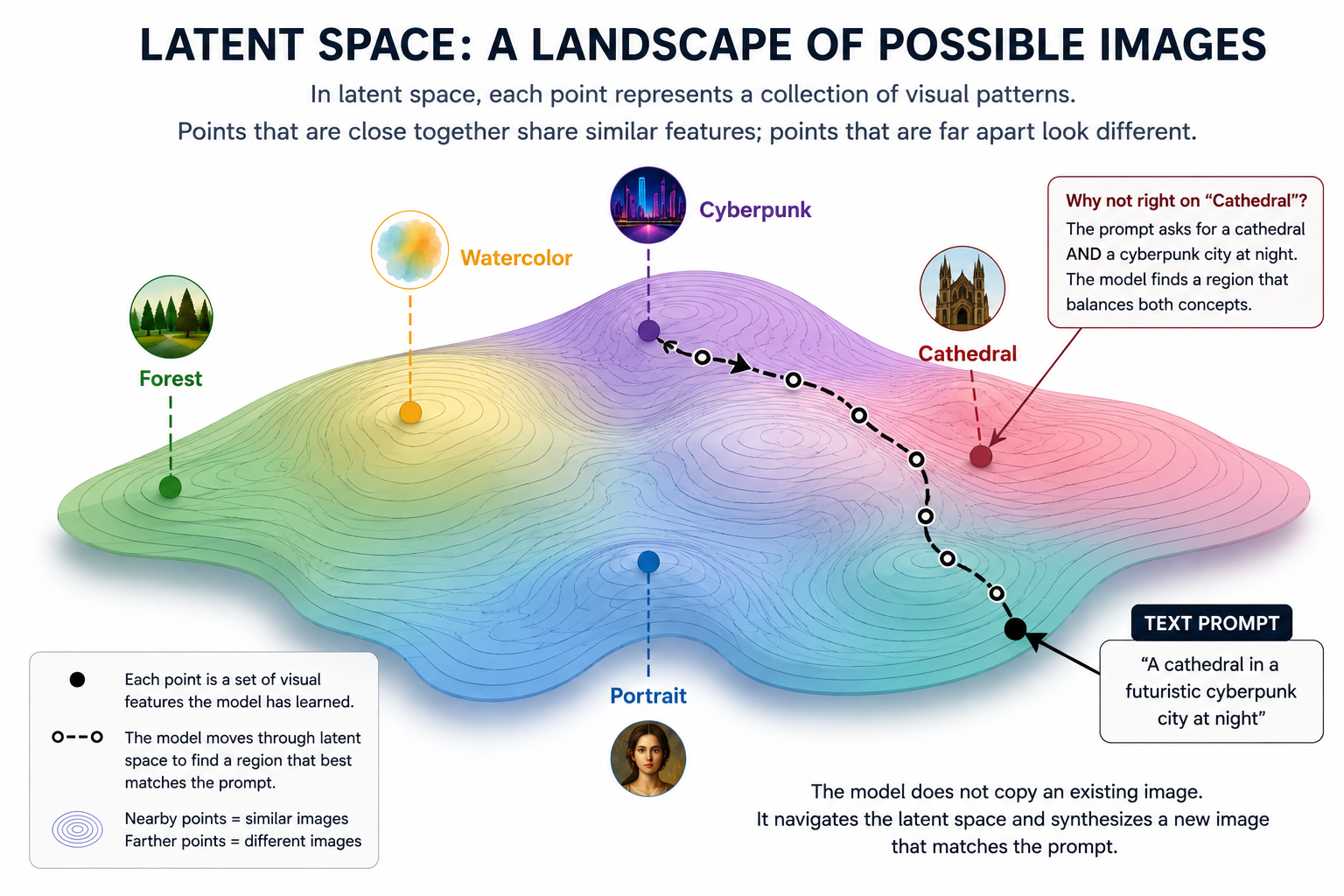
Graphic generated by ChatGPT according to author specifications. Click the image to open it full size.
This is why image generators can combine seemingly unrelated ideas—a cathedral made of glass, a medieval manuscript depicting a spaceship, or a portrait painted in the style of an old photograph. The model is not imagining these scenes as a person would. It is navigating learned visual relationships and synthesizing an image that best matches the prompt.
Synthetic Media
AI-generated images, video, voices, music, and animation are all forms of synthetic media. These technologies support creative experimentation, rapid prototyping, accessibility, scientific visualization, and new forms of storytelling. They can also be used to create convincing misinformation, impersonate individuals, generate non-consensual imagery, or flood digital platforms with low-quality content.
Understanding diffusion models helps us see that AI images are not magic. They are the result of training data, mathematical models, prompts, and countless learned relationships among visual patterns. The next section turns from how these systems work to how people can work creatively and critically with them.
7.5
Human-AI Collaboration
AI tools are often described as replacements for human work, but they are increasingly used as collaborators that extend human thinking, creativity, and productivity. In creative, educational, and professional settings, people use AI to brainstorm ideas, revise writing, generate variations, translate concepts into different media, write code, analyze data, and create images, sound, and video.
Prompting is the practice of giving instructions or context to an AI system. A prompt can be a question, a command, a role, an example, a constraint, or a creative direction. Good prompting is less like pushing a button and more like setting up a conversation, experiment, or design process.
The worn-path image from Section 7.2 helps explain why prompting matters. A generic prompt asks the model to follow only the deepest channels of its training, often producing the most predictable and derivative results—sometimes called slop. A specific, constraint-rich, or unexpected prompt encourages the model to move beyond those well-worn paths. The resulting output is less predictable, but often more original, more focused, and more clearly shaped by human intention.
Critical Use
Human–AI collaboration requires judgment. AI systems can produce useful drafts, but they can also generate errors, stereotypes, clichés, unsupported claims, fabricated citations, and confident nonsense. The user remains responsible for evaluating, revising, contextualizing, and deciding what belongs in the final work.
- Use AI to generate possibilities, not final truth.
- Consider how the prompt itself shapes the response.
- Ask for alternatives and compare results.
- Check facts, sources, code, and citations.
- Revise outputs in your own language and style.
- Disclose AI assistance when required or ethically appropriate.
The most valuable AI literacy may not be knowing how to produce the fastest output. It may be knowing how to slow down, question the output, and use AI to support more thoughtful human work.
The Human Flows of AI
It is easy to imagine AI as a single machine that lives "in the cloud." In fact, every AI system depends on a long chain of flows: materials pulled from the earth, energy from power grids, chips built in factories, data created by billions of people, and data centers that train and run the models. From there the flow continues outward, as AI moves into workplaces, schools, hospitals, phones, and communities. At every stage there are people: doing the work, supplying the data, living near the infrastructure, and living with the results.
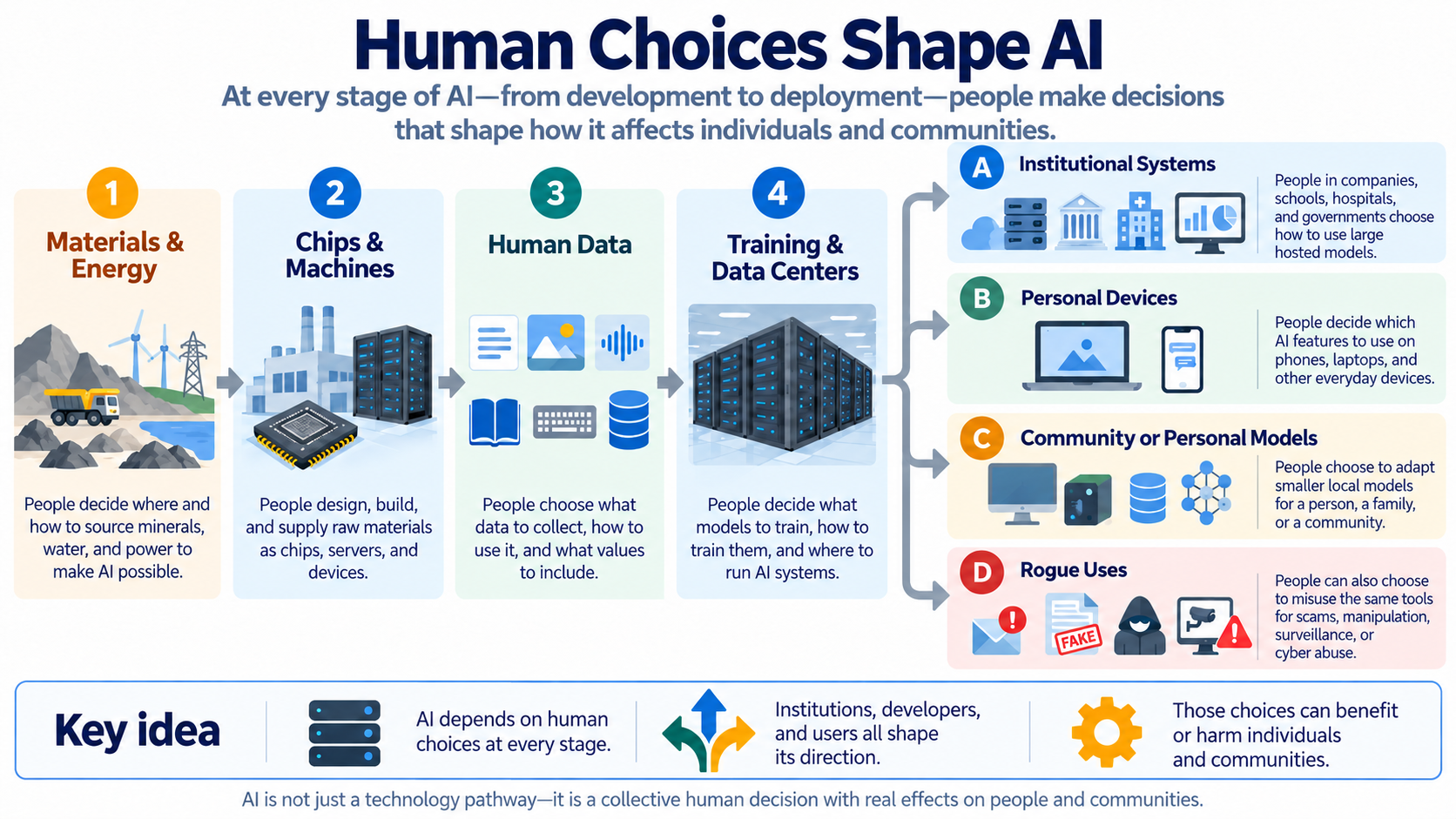
Graphic generated by ChatGPT according to author specifications. Click the image to open it full size.
People at Every Stage
1. Materials and energy: AI hardware depends on minerals such as lithium, cobalt, copper, and rare earth elements, along with large amounts of electricity and water. Miners, refinery workers, and energy workers make this possible, often in places far from where AI is used. Communities near mines and power plants can bear the environmental costs.
2. Chips and machines: Engineers design chips, factory workers produce them, and technicians assemble servers and devices. Advanced chip manufacturing is concentrated in a small number of companies and countries, which gives them great influence over who can build AI.
3. Human data: Models learn from text, images, sound, and code made by people: writers, artists, programmers, students, and anyone who has posted online. Behind the scenes, data workers label images, rate chatbot answers, and filter harmful content, often for low pay and sometimes at a real psychological cost. Their work makes AI systems appear seamless. Chapter 06 looks at questions of consent and ownership in training data.
4. Training and data centers: Data centers are large buildings full of servers that train and run AI models. Construction crews, electricians, and technicians build and maintain them. They also use large amounts of electricity and water, and they can strain local power grids and water supplies. Some communities welcome data centers for the jobs and tax revenue they bring; others push back over rising energy costs, noise, land use, and water. Where data centers are built, and who gets to decide, has become a local political question in many places.
Where AI Flows
After training, AI branches into different forms of use. Large hosted models are used by institutions such as companies, governments, schools, and hospitals to answer questions, screen applications, support diagnoses, and deliver services. AI features on personal devices shape how people write, search, take photos, and communicate. Smaller community or personal models can run locally and be adapted for a person, a family, or a community, giving people more control over their own data. And the same tools can be turned to rogue uses, such as scams, deepfakes, harassment, and surveillance.
As AI flows into education, health care, social networks, and everyday life, it shapes human well-being. Teachers redesign assignments, patients receive care that depends on AI tools, workers find their jobs reshaped, and users spend their attention on platforms tuned by AI. These effects are human effects, and the technology alone does not decide them.
Alignment at Every Stage
In AI research, alignment usually means making sure a model's behavior matches human intentions and values: that it is helpful, honest, and avoids causing harm. This is important work. But if people are involved at every stage of AI, then every stage can be aligned, or misaligned, with human interests. A model that behaves well in a chat window can still depend on unsafe mines, underpaid data workers, or a data center that drains a town's water supply. Asking whether AI is aligned means asking questions along the whole chain:
- Materials and energy: Are workers safe and fairly paid? Do affected communities have a say?
- Chips and machines: Who controls production, and who is left out?
- Human data: Did people consent to the use of their work? Are data workers paid fairly and protected?
- Data centers: Are local communities consulted about energy, water, and land?
- Institutions: Are AI systems in schools, hospitals, and governments fair, transparent, and accountable? Can people challenge a decision made with AI?
- Personal use: Does the tool support people's well-being, or does it exploit their attention and data?
7.6
Unit Exercise: Generative Media Experiment
Generative AI can produce something in seconds. But producing is not the same as deciding. In this exercise you will build a short creative piece with an AI in two halves: first you steer, then you let the AI steer. Comparing the two halves will show you what the AI does well, and what it does when no one tells it what matters.
Choose any form: a short story, a poem, a character, or a series of images. Use one AI tool, and stay in the same conversation the whole time.
Part 1. You Lead (5 steps)
- Start with a seed of your own: one sentence, one image idea, or one character.
- For each of the next steps, give the AI a specific direction: add something, cut something, change the mood, shift the point of view.
- After each step, save the output and write one line: did it do what you meant?
Part 2. The AI Leads (5 steps)
Now stop giving directions. For each step, use only an indirect prompt, such as:
- "Continue."
- "What should happen next?"
- "Make it better."
- "Surprise me."
Save every output. Don't fix or correct anything. Just watch where it goes.
Part 3. Look Back
Lay out all ten steps side by side and consider:
- Where did the work go when no one was steering? Did it get more dramatic, more detailed, more predictable, more tidy?
- What did "make it better" mean to the AI? Better according to whom?
- Did the AI ever take a real risk, or did it follow the most expected path (the worn paths from Section 7.2)?
- What did you know about the piece that the AI never asked about?
- Was there a moment when the AI seemed intelligent? What made it seem that way?
Write one paragraph answering this question: What is the difference between generating and deciding?
Submit your ten outputs, your prompts, your one-line notes from Part 1, and your paragraph.
Discussion Questions
- An AI can always continue, but it never needs to. What does that tell us about intelligence?
- How do prompts shape, not merely request, the output?
- If AI becomes better at generating media, what human abilities become more valuable rather than less?
7.7
Glossary
- artificial intelligence: computer systems designed to perform tasks associated with intelligence, such as recognizing patterns, generating media, making predictions, or supporting decisions.
- symbolic ai: an approach to artificial intelligence based on explicit rules, logic, and symbolic representations. Also called Good Old-Fashioned AI (GOFAI).
- turing test: a test proposed by Alan Turing in 1950 that asks whether a machine can imitate human conversation well enough that a person cannot reliably tell it apart from a human.
- machine learning: a method of computing in which systems learn patterns from data rather than following only fixed rules.
- model: a trained AI system that can produce outputs based on patterns learned from data.
- training data: data used to teach a machine learning system to recognize patterns or generate outputs.
- neural network: a machine learning system made of connected layers that transform input data into output.
- weight: a number stored inside a neural network that represents the strength of a connection between two parts of the model. Training adjusts millions or billions of weights to encode the patterns the model will use.
- backpropagation: the process of working backward through a neural network to adjust its weights after each training example. Repeated many times, backpropagation is how a model carves out the patterns it will later use to generate output.
- machine vision: the branch of AI that enables computers to interpret photographs and video.
- large language model: an AI model trained on large collections of text to generate and respond to language.
- token: a small unit of text, such as a word, part of a word, or punctuation mark, used by language models.
- next-token prediction: the process of generating language by predicting the next likely token in a sequence.
- emergent behaviors: abilities that appear in large AI models without being explicitly programmed, such as translation or summarization. Researchers debate how sudden or real these jumps are.
- transformer: a machine learning architecture used by many contemporary language models to process relationships across sequences of text.
- attention: a process that helps an AI model weigh relationships among parts of an input, such as words in a sentence.
- multimodal: describes AI systems that can work with more than one kind of data, such as text, images, audio, and video.
- diffusion model: a generative AI system that creates images by learning how to transform noise into visual patterns.
- latent space: a compressed mathematical space where relationships among data, images, words, or concepts can be represented.
- synthetic media: media generated or significantly altered by computational systems, including AI-generated images, video, voices, music, or text.
- prompting: the practice of giving instructions, context, examples, or constraints to an AI system.
- hallucination: an AI output that appears plausible but is inaccurate, unsupported, or invented.
- bias: a pattern of unfairness or distortion that may appear in an AI system because of training data, design choices, or social inequalities.
- alignment: the effort to make AI systems act in line with human intentions and values. More broadly, the question of whether each stage of AI, from materials to deployment, serves human interests.
- data center: a facility full of servers that store data and train and run AI systems, often using large amounts of electricity and water.
- generative ai: AI systems that create new text, images, audio, video, code, or other media from prompts or input data.
7.8
Bibliography
Boden, Margaret A. AI: Its Nature and Future. Oxford University Press, 2016.
Broussard, Meredith. Artificial Unintelligence: How Computers Misunderstand the World. MIT Press, 2018.
Crawford, Kate. Atlas of AI: Power, Politics, and the Planetary Costs of Artificial Intelligence. Yale University Press, 2021.
Mitchell, Melanie. Artificial Intelligence: A Guide for Thinking Humans. Farrar, Straus and Giroux, 2019.
Noble, Safiya Umoja. Algorithms of Oppression: How Search Engines Reinforce Racism. NYU Press, 2018.
Russell, Stuart. Human Compatible: Artificial Intelligence and the Problem of Control. Viking, 2019.
Christian, Brian. The Alignment Problem: Machine Learning and Human Values. W. W. Norton, 2020.
Gray, Mary L., and Siddharth Suri. Ghost Work: How to Stop Silicon Valley from Building a New Global Underclass. Houghton Mifflin Harcourt, 2019.
Li, Fei-Fei. The Worlds I See: Curiosity, Exploration, and Discovery at the Dawn of AI. Flatiron Books, 2023.
Mollick, Ethan. Co-Intelligence: Living and Working with AI. Portfolio, 2024.
Pasquinelli, Matteo. The Eye of the Master: A Social History of Artificial Intelligence. Verso, 2023.