2008
ELL opens as a reading room for scholars to engage with born-digital media
ELL’s history starts with the exhibition Grigar curated for the Electronic Literature
Organization’s 2008 conference. Entitled "Early Authors of Electronic Literature: The
Eastgate School, Voyager Artists, and Independent Productions," the event made it possible
for visitors to access floppy disks and CD-ROMs held in her personal library on legacy
computers she owned and had access to. The positive response she received made it clear a
space dedicated to experiencing born-digital art, literature, and was needed.
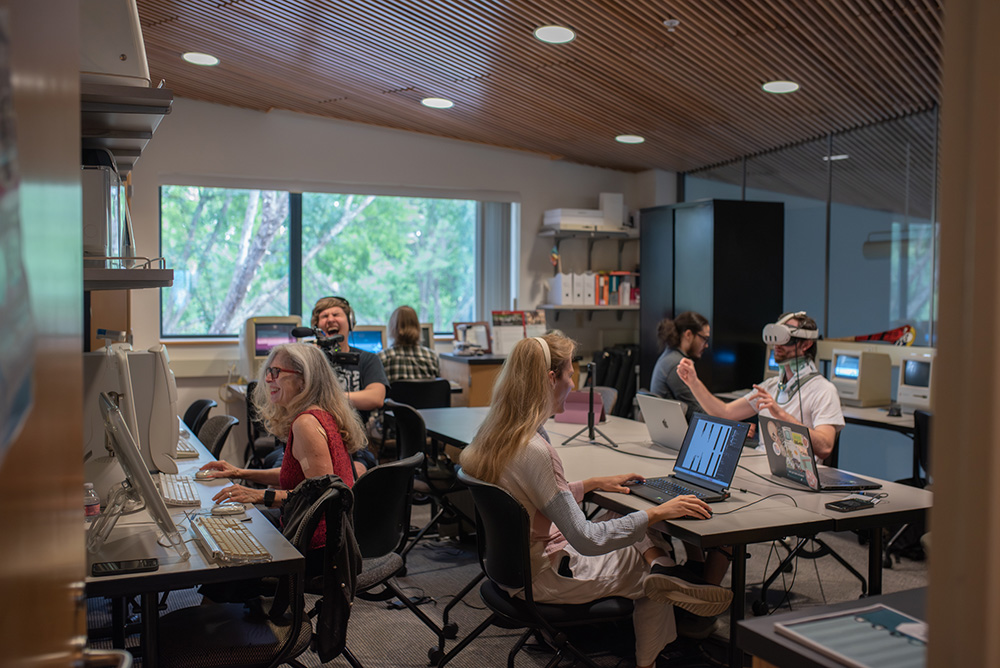
On July 15, 2010 Grigar requested a room on campus for a reading room called the
“Electronic
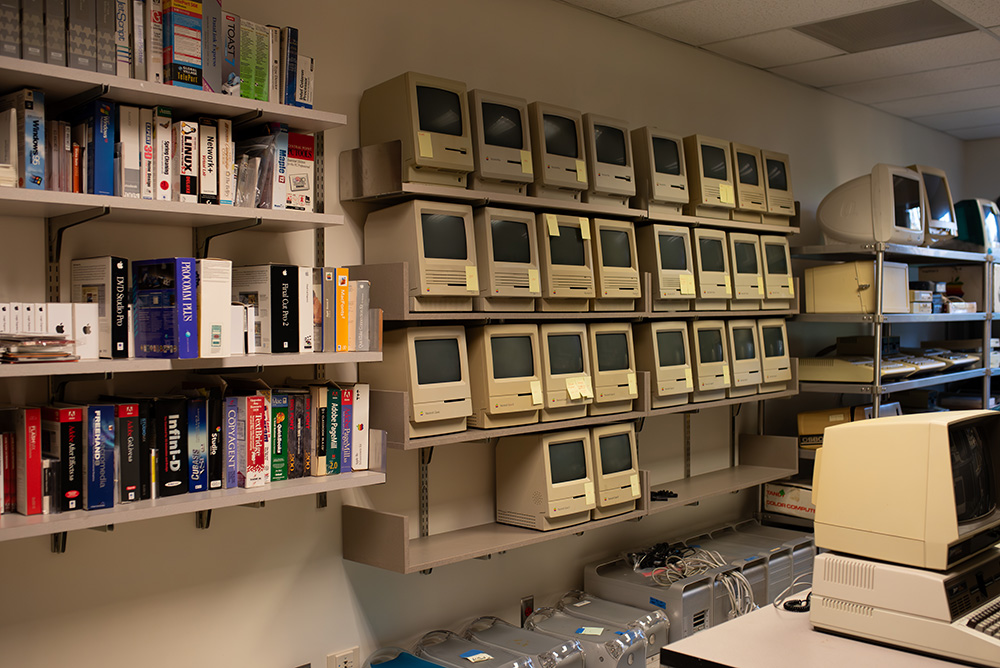
Literature Lab.” Six months later, on January 10, 2011 Grigar moved into ELL and set
up her
16 legacy computers and organized her personal library of born-digital media. Shortly after,
on April 15, 2011 Anne Balsamo visited ELL and suggested ideas for its future
use.
National and international recognition led to ELL moving to a more visible space in April
2015, where the Reading Room continues its mission to provide access.
2013
ELL expands its mission to include innovating documentation methodology for born-digital
literature
With Anna Balsamo's and Stuart Moulthrop's support, Grigar and Moulthrop receive an NEH grant
in April 9, 2013 for Pathfinders, with the first Traversal, Moulthrop’s Victory
Garden,
taking place on July 8-11, 2013. John McDaid's Traversal of Uncle Buddy’s Phantom
Funhouse followed on August 7-10, 2013, and Shelley Jackson's Traversal of
Patchwork Girl on October 17-20, 2013. Others, Bill Bly's Traversal of We
Descend (with support from Matt Kirschenbaum) and Judy Malloy's Traversal of
Uncle Roger were held outside of ELL.
On June 1, 2015 the Pathfinders multimedia "Scalar" book was published. A few days
later on June 4, 2015 Grigar and Moulthrop sign the contract for Traversals with
The MIT Press. The book was published on April 2017.
ELL continued to hold Traversals and publishing results in Rebooting Electronic
Literature, Volumes 1-5 from 2018- 2021.
2016
ELL becomes involved in archiving and making born-digital art, literature, and games
accessible to the public
Beginning December 2016, ELL was given the archives belonging to the trAce Online Writing
Centre, with support from Sue Thomas; and Turbulence.org, with support from Helen Thorington
and Jo-Anne Green. Realizing the need to create a space for the archives to be accessible to
the public, Grigar submitted a proposal to The Alfred W. Mellon Foundation to build a
repository. The grant was awarded in May 2018 that year. Six months later, on December 30,
the Electronic Literature Repository (ELR) went live with seven collections: trAce,
Turbulence, Alan Bigelow, Stephanie Strickland, Marjorie C. Luesebrink, N. Katherine Hayles,
and David Kolb.
The need to showcase the digital archives more aesthetically led to the ELR to be
re-envisioned as a museum and library called The NEXT and built with open Web languages. The
work was undertaken by graduating seniors of the Digital Technology and Culture Department
at the Vancouver campus. The NEXT launched on May 6, 2020.
Broad accessibility remained a goal, so in 2021 ELL team members Holly Slocum and Greg
Philbrook rebuilt The NEXT with Semantic Markup and ARIA so that it was accessible via
machine readers. They also continued to innovate its design. The next year, in 2022, ELL was
given the 2022 Open Scholarship Award by The Canadian Social Knowledge Institute for The
NEXT.
Innovation continued with the move to make The NEXT's Visualization space accessible as a
Virtual Reality experience. Grigar was awarded a grant from WSU Vancouver to achieve this
goal.
2019
ELL begins to conserve work by restoring and reconstructing born-digital art, literature,
and games held in the archives to ensure outmoded works are accessible to the public
In 2019 ELL restored Deena Larsen's 17 "Kanji-Kus" poems by moving them out of iFrames and
programming the functionality provided by the Java Applets with JavaScript. In January 2020
ELL picked up its first conservation project: Annie Grosshan's The World Is Not Done
Yet; it also begins to preserve Flash works with Ruffle.
ELL worked with students from the DTC Vancouver’s 2021 graduating class to translate
Thomas
Disch's Amnesia, for the Web, calling the project Amnesia Restored; during
that same year the ELL Team reconstructed Richard Holeton's hypertext novel, Figurski at
Findhorn on Acid.
Conservation efforts continued in 2022 with ELL building David's Kolb's "Caged Text," a work
originally planned for his essay, Socrates in the Labyrinth that had remained
unfinished since 1997. The lab also led a team of DTC Vancouver seniors to translate Sarah
Smith's King of Space for the Web, and the led reconstructed Stuart Moulthrop's
hypertext novel, Victory Garden.
The next year in 2023 ELL reconstructed Bill Bly's We Descend and led DTC seniors
to reconstruct John McDaid's Uncle Buddy's Phantom Funhouse.
In the spring of 2024 ELL began work on Christy Sanford's "Red Mona" and oversaw the
Undergraduate Researcher, James Lesperance, efforts to develop a NetProv engine aimed at
documenting Rob Wittig's corpus, a project funded by WSU Vancouver's Undergraduate Research
Fellow Award.
2020
ELL innovates metadata for born-digital media that are interactive, participatory, and
experiential
In 2020, ELL created the first iteration of its unique metadata schema, ELMS 1.0, by
modifying the schema developed by The CELL Project, which had extended with the controlled
vocabularies of MODS. ELL continued to refine the ELMS metadata schema to include more
descriptive controlled vocabularies and additional fields, calling this version, ELMS 2.0,
in 2022. That same year Grigar and ELL's Associate Director Richard Snyder participated in
Triangle SCI 2022 to develop controlled vocabularies that attended to the needs of people
with disabilities and sensory sensibilities, a project resulting in ELMS 3.0.
In June 2023, Grigar and Snyder were awarded a grant from the Society of American Archivists
to test and implement ELMS 3.0 to 30 works in The NEXT. With the successful outcome from the
testing, Grigar submitted a proposal in January 2024 for a Level III Advancement Grant from
the National Endowment for the Humanities to fund the implementation of ELMS 3.0 to all
works in The NEXT. The grant was not funded.
Work on metadata refinement continued with a focus on works produced for Extended Reality
(XR) environments, an outcome of the Future of Text in XR project Grigar led in 2024-2026
and was funded by the Alfred P. Sloan Foundation.
2024-2026
ELL continues to grow its space and mission
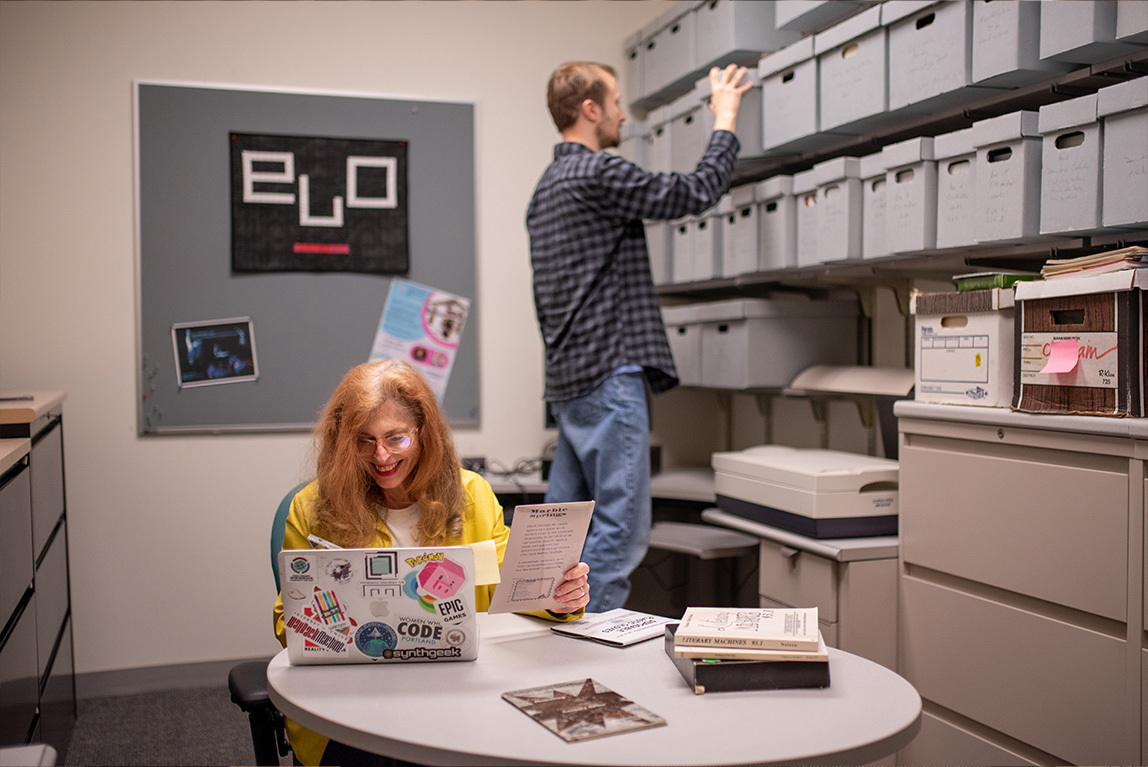
On April 11, 2024 ELL was given a room for the physical archives it had been collecting since
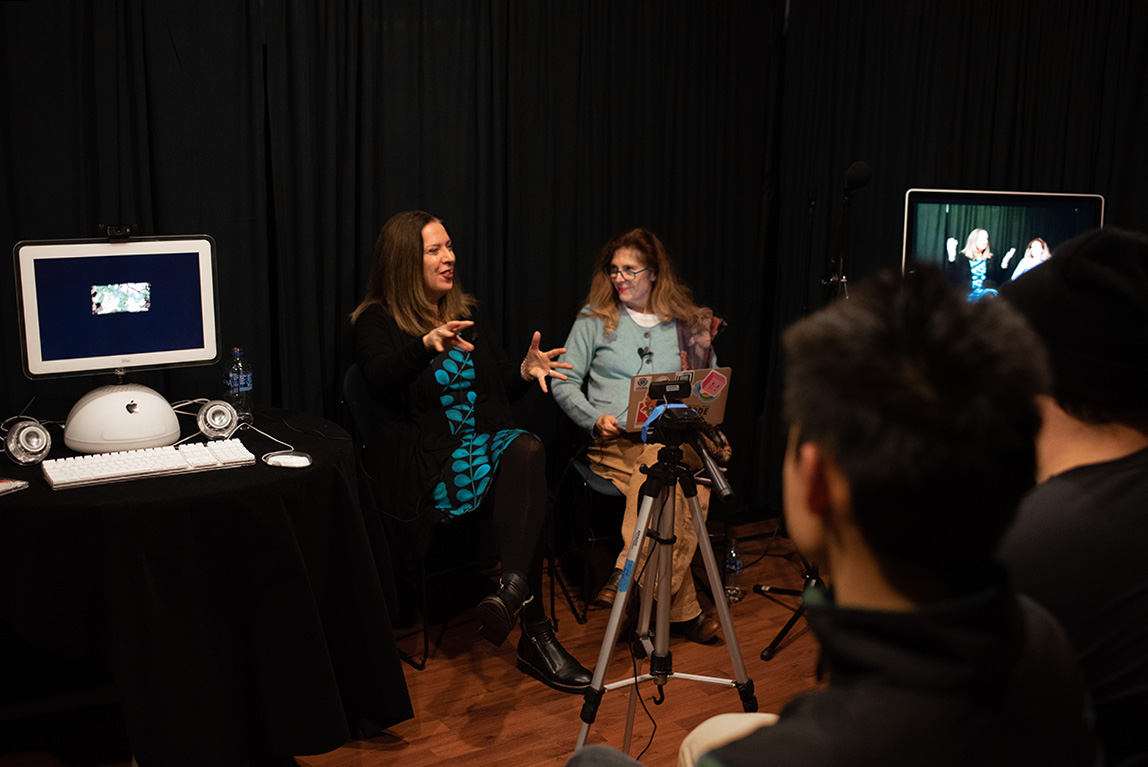
2016, calling it the “Archives Room.” That same year the lab renamed the MOVE
Lab where it
had been holding its Live Traversals and interviews, as “The
Studio.”
With a long interest in virtual environments, Grigar, with Co-PI Frode Hegland, submitted
and were awarded a grant from the Alfred P. Sloan Foundation to experiment with academic
reading and writing in XR environments. Work on the project commenced in December 2024 with
ELL team member Andrew Thompson taking the role of XR Programmer.
Grigar and Thompson gave a TedXTalk on March 8, 2025 at Marshall University about the VR
integration at The NEXT. A few months later on May 18, 2025, the lab was featured in an article published by the BBC News and Stories about its
collection of hardware and software.
Conservation work also continued in June 2017 with a grant from the Society of American
Archivists (SAA) Catalyst to document 78 works created with Shockwave Director via
Traversals.
On July 23, 2025 the lab dedicated the Reading Room to Marjorie C. Luesebrink and celebrated
the event with a Traversal by Stephanie Strickland and Grigar of Luesebrink's hypertext
novel, Egypt: The Book of Going Forth by Day. The space is now known as The
Marjorie C. Luesebrink Reading Room.
Donations of hardware and software followed after the publicity from the BBC
article, inspiring the lab to put more focus on retro computing efforts and seek additional
space to hold its growing collection. In January 2026 the lab expanded into its new space,
called the Restoration Room.
In February 2026 Grigar submitted a proposal to the ELO 2026 conference for a workshop to
provide guidance to born-digital artists and scholars about preparing digital and physical
archives for long-term access. She also began work on her next book, entitled Archival
Storytelling.